By Dave Robbins
Traduzione in italiano a cura di Patrizia Burlini
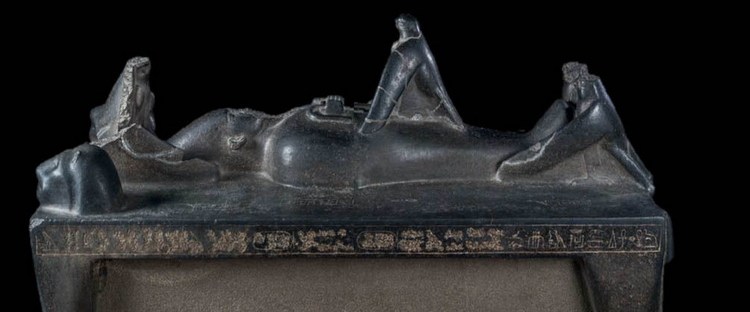
We now reach the end of the 30th Century BCE with the reign of King Djer who is thought to have reigned as many as 41 years. Unfortunately, I did not have very interesting photos of Djer (Oooh! Arrowheads! Wouldn’t you have been excited?  ) so, I will take a short break from my own collection of photos to show you my very favorite artifact that, sadly, I have yet to see with my own eyes. That’s because the Bier of Osiris, found in the Tomb of Djer at Umm el-Qa’ab in the low western desert of Abydos, has always been in a traveling exhibition for five or more years … even when I was last in the Egyptian Museum in November.
Giungiamo ora alla fine del 30° secolo a.C. con il regno del re Djer, che si pensa abbia regnato per ben 41 anni. Sfortunatamente, non avevo foto molto interessanti di Djer (Oooh! Punte di freccia! Non vi sareste emozionati? ), quindi farò una breve pausa dalla mia collezione di foto per mostrarvi la mia opera d’arte preferita che, purtroppo, non ho ancora visto con i miei occhi. Questo perché il Catafalco di Osiride, trovato nella Tomba di Djer a Umm el-Qa’ab nel basso deserto occidentale di Abydos, è sempre stato in una mostra itinerante per cinque anni o di più…anche quando sono stato l’ultima volta al Museo Egizio in novembre.

Shown in the accompanying photo shortly after it was found in the Tomb of Djer in Umm el-Qa’ab, the Bier of Osiris was excavated by Emile Amelineau, a French Egyptologist, in 1898.
Mostrato nella foto di accompagnamento poco dopo il suo ritrovamento nella Tomba di Djer a Umm el-Qa’ab, il Catafalco di Osiride fu trovato da Emile Amelineau, un egittologo francese, nel 1898.
From the New Kingdom onwards, the Tomb of Djer was regarded as the Tomb of Osiris and it was here that the famous five-day passion play of Osiris was re-enacted to commemorate the Myth of Osiris. How do we know this? The details of the passion play are recorded on the Dynasty 12 Stela of Ikhernofret now in the Neues Museum in Berlin. We call the passion play the Khoiak Festival but that’s a Coptic name. The ancient Egyptians called it kaherka or ( 𓂓 𓁷 𓏤 𓂓 𓎱 𓇳 ). As you can see, there is a heb sign (𓎱) shown to indicate that it was a festival. Some of the activities during the festival were shaping earth to look like the profile of Osiris. Seeds were sown in a ceramic Osiris Mold and then watered until germination.
A partire dal Nuovo Regno, la Tomba di Djer fu considerata la Tomba di Osiride ed è qui che veniva rievocata la famosa rappresentazione della passione di Osiride, della durata di cinque giorni, per commemorarne il Mito. Come lo sappiamo? I dettagli della rappresentazione della passione sono riportati sulla stele di Ikhernofret della Dinastia 12, oggi conservata al Neues Museum di Berlino. Noi chiamiamo la rappresentazione della passione il Festival di Khoiak, ma è un nome copto. Gli antichi egizi la chiamavano kaherka o ( 𓂓 𓁷 𓏤 𓂓 𓎱 𓇳 ). Come si può notare, è presente un segno heb (𓎱) per indicare che si trattava di un festival. Alcune delle attività svolte durante la festa consistevano nel modellare la terra in modo che assomigliasse al profilo di Osiride. I semi venivano posti in uno stampo a forma di Osiride in ceramica e poi annaffiati fino alla germinazione.
But back to Djer! Remember? Dynasty I’s third king?  According to Josef Wegner, his serekh name (meaning “Defender of Horus”) is pronounced “JAIR” as in chair, and his name is spelled as 𓇦 (M37 among Gardiner numbers). On the Abydos Kinglist in the Temple of Sety I, his name appears as his throne name or 𓇋 𓏏 𓍘 (Iteti). He is thought to be the son to Hor-Aha and Hor-Aha’s other wife named Khenthap. When his tomb was found, his mummified arm was found with four bracelets around his wrist (of which I will post a photo of in the comments along with a photo of his tomb … now back-filled).
Ma torniamo a Djer! Ricordate? Il terzo re della I dinastia? Secondo Josef Wegner, il suo nome serekh (che significa “Difensore di Horus”) si pronuncia “JAIR” come “chair” ( sedia in inglese, n.d.T.), e il suo nome è scritto come 𓇦 (M37 tra i simboli Gardiner). Nella lista reale di Abydo, nel Tempio di Sety I, il suo nome appare come nome di intronizzazione, ovvero 𓇋 𓏏 𓍘 (Iteti). Si pensa che fosse figlio di Hor-Aha e dell’altra moglie di Hor-Aha, di nome Khenthap. Quando fu scoperta la sua tomba, il suo braccio mummificato fu trovato con quattro braccialetti intorno al polso (di cui pubblicherò una foto nei commenti insieme a una foto della sua tomba… ora ricoperta).
 LA CIVILTA' EGIZIA