By Dave Robbins
Traduzione in italiano a cura di Patrizia Burlini
As you may remember, I started with the first king of Dynasty I and his name is Narmer. In his case, at least we had an image of him on his famous palette which, until 25 years ago, also contained the earliest-known hieroglyphs. Now, that oldest record of hieroglyphs has been superseded by even earlier hieroglyphs on tags found by Gunter Dryer in Umm el-Qa’ab in Abydos.
Come ricorderete, ho iniziato con il primo re della I dinastia e il suo nome è Narmer. Nel suo caso, almeno avevamo una sua immagine sulla famosa tavolozza che, fino a 25 anni fa, conteneva anche i primi geroglifici conosciuti. Ora, questa più antica testimonianza di geroglifici è stata superata da geroglifici ancora più antichi su cartellini trovati da Gunter Dryer a Umm el-Qa’ab ad Abydos.

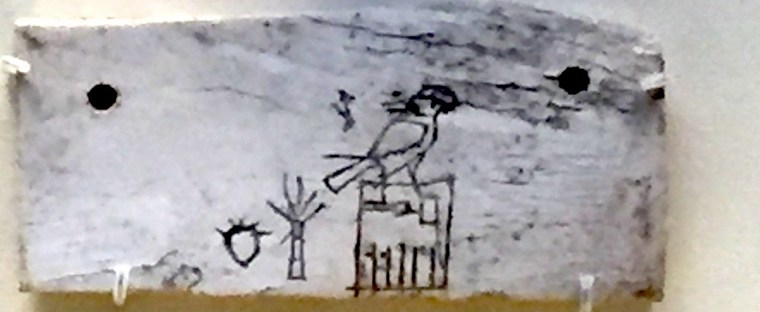
But pictured is yet other very ancient hieroglyphs … those of the 2nd king of Dynasty 1, Hor-Aha, and his wife, Benerib. The hieroglyphs were found on a fragment from a box made from hippopotamus ivory also found at Umm el-Qa’ab. Once again, we see a falcon standing above the serekh or palace facade used for the Horus or serekh name of the king, that being Hor-Aha, sometimes just referred to as “Aha” and spelled with the shield and mace (D34) shown as: 𓂚 (Admittedly, it’s not an exact match but it’s close and I’ll go along with it.)
Ma la foto mostra altri geroglifici molto antichi… quelli del secondo re della I Dinastia, Hor-Aha, e di sua moglie, Benerib. I geroglifici sono stati trovati su un frammento di una scatola in avorio di ippopotamo, anch’essa rinvenuta a Umm el-Qa’ab. Ancora una volta, vediamo un falco che si erge sopra il serekh o facciata del palazzo usato per il nome Horus o serekh del re, che è Hor-Aha, a volte indicato semplicemente come “Aha” e scritto con lo scudo e la mazza (D34) mostrato come: 𓂚 (certo, non è una corrispondenza esatta, ma è vicina e la seguo).
To the left, we see the name of Benerib which means the queen was just called “Sweetheart!”  It’s true! The “ib” (𓄣) means heart … that being the same heart you see on the scale in the Judgment Hall and the “bnr” or “bener” (𓇟) means “sweet.”
A sinistra, vediamo il nome di Benerib, il che significa che la regina si chiamava semplicemente “sweetheart” (traduz. Letterale : cuore dolce, che noi in italiano rendiamo con dolcezza, n.d.T)! È vero! L'”ib” (𓄣) significa cuore… che è lo stesso cuore che si vede sulla bilancia nella Sala del Giudizio e il “bnr” o “bener” (𓇟) significa “dolce”.
The “Ivory Box fragment of Hor-Aha” is found in the British Museum and carries the accession number of EA 35513. My photo is from December 2017.
Il “frammento di scatola d’avorio di Hor-Aha” si trova al British Museum e porta il numero d’accesso EA 35513. La mia foto è del dicembre 2017
 LA CIVILTA' EGIZIA