
By Dave Robbins
Traduzione in italiano a cura di Patrizia Burlini
So far, we have covered the first five monarchs i.e.
𓇓 𓏏 𓆤 𓏏 (nesu-bity) and their queens i.e. 𓈞 𓏏 𓇓 𓅨 (hemet-nesu-weret) which I summarize below (where the regnal years are purely guesswork):
reg-yrs / length / dynasty / royalty
3072-3012 60 01-01 Narmer, Neithhotep?
3012-2980 32 01-02 Hor-Aha, Benerib, Khenthap
2948-2907 41 01-03 Djer,Nakhtneith
2907-2897 10 01-04 Djet, Merneith
2897-2887 10 01-05 Merneith (regent and probable monarch)
Finora abbiamo trattato i primi cinque monarchi, vale a dire
𓇓 𓏏 𓆤 𓏏 (nesu-bity) e le loro regine, ovvero
𓈞 𓏏 𓇓 𓅨 (hemet-nesu-weret) che riassumo di seguito (dove gli anni di regno sono puramente indicativi):
anni regno/ durata / dinastia / nomi reali
3072-3012 60 01-01 Narmer e Neithhotep?
3012-2980 32 01-02 Hor-Aha e Benerib, Khenthap
2948-2907 41 01-03 Djer e Nakhtneith
2907-2897 10 01-04 Djet e Merneith
2897-2887 10 01-05 Merneith (reggente e probabile monarca)
I acknowledge that I did not mention Neithhotep or Nakhtneith but that’s because I know absolutely nothing about them and, as indicated by the question mark, it’s apparently not even certain with Narmer’s consort.
Ammetto di non aver menzionato Neithhotep o Nakhtneith, ma questo perché non so assolutamente nulla di loro e, come indicato dal punto interrogativo, non c’è certezza neppure sulla consorte di Narmer.
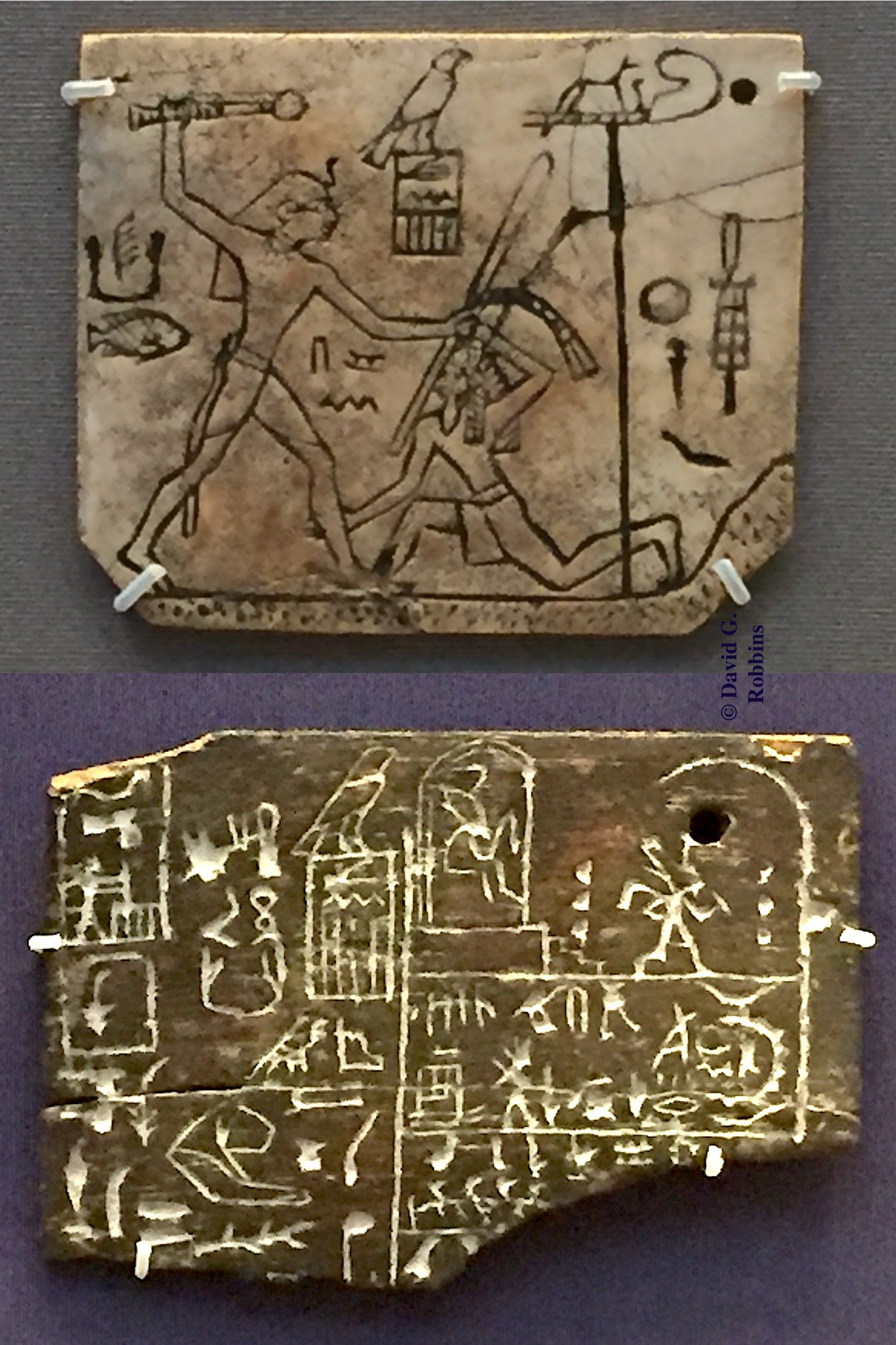
This now brings us fully into the 29th Century BCE with the 42-year reign of Den (technically 32 years since his mother was co-regent for the first 10). As you can see in the top image of my two-photo collage, Den imitates the same smiting motif as we saw in Narmer on his palette. I photographed both the ivory label of Den (top) and the Ebony Label of Den just moments apart as they are both in the same display case in the British Museum.
Questo ci porta nel 29° secolo a.C. con i 42 anni di regno di Den (tecnicamente 32 anni, dato che sua madre fu coreggente per i primi 10). Come si può vedere nell’immagine superiore del mio collage di due foto, Den imita lo stesso motivo della percussione che abbiamo visto nella tavolozza di Narmer. Ho fotografato sia la placca in avorio di Den (in alto) sia la placca in ebano di Den a pochi istanti di distanza l’una dall’altra, poiché si trovano entrambe nella stessa vetrina del British Museum.
Just to the right of Den’s face (on the ivory label), you can see his serekh (𓊁 ) with his name in the top part as Den with the hand (𓂧/D) and the water ripple (𓈖/n). This is where the names of deities almost always appear … just to the right of the face. So when you go to Egypt, just have a chart on your smart phone and you can probably read the name of any deity on a wall or in a museum. Later, in Egyptian history though, the cartouche gets invented and royal names (birth names and throne names) are always then shown in cartouches. Deities, however, remain to the right of the face pretty consistently forever.
Proprio a destra del volto di Den (sulla placca in avorio), si può vedere il suo serekh (𓊁 ) con il suo nome nella parte superiore come Den con la mano (𓂧/D) e l’increspatura dell’acqua (𓈖/n). È qui che compaiono quasi sempre i nomi delle divinità… proprio a destra del volto. Quindi, quando andrete in Egitto, basterà avere uno schema sul vostro smartphone e probabilmente riuscirete a leggere il nome della divinità su un muro o al Museo. Più tardi, nella storia egizia, fu inventato il cartiglio e i nomi reali (nomi di nascita e nomi di intronizzazione) sono sempre riportati in cartigli.
Both labels were found at Den’s tomb at Umm el-Qa’ab in the spoil heaps of Émile Amélineau meaning he didn’t find them or didn’t consider them important. Flinders Petrie saw such things of the highest importance and, of course, Petrie was right especially since this is possibly the earliest images (along with Narmer’s Palette) that we have of an Egyptian pharaoh.
Entrambe le placche sono state trovate nella tomba di Den a Umm el-Qa’ab nei cumuli di scarto di Émile Amélineau, il che significa che egli non le trovò o considerò importanti. Flinders Petrie considerava questi oggetti della massima importanza e, naturalmente, Petrie aveva ragione, soprattutto perché queste sono forse le prime immagini (insieme alla Paletta di Narmer) che abbiamo di un faraone egizio.
The right hand side of the Ivory Label depicts the Standard of Wepwawet as you can see the jackal at the top of the standard. The hieroglyphs say, basically, “first occasion of smiting the East.” 𓐓 𓊗 𓌐𓋁
Il lato destro della placca in avorio raffigura lo stendardo di Wepwawet, come si può vedere dallo sciacallo in cima allo stendardo. I geroglifici dicono, in sostanza, “prima occasione di colpire l’Oriente”. 𓐓 𓊗 𓌐𓋁
The Ebony Label on the bottom shows more hieroglyphs than I can possibly explain here but the most important part is that in the top right in which we see Den portrayed both enthroned under a canopy at left and performing in his heb sed on the right. The heb sed was a festival held typically in the 30th year of a pharaoh’s reign in order to “rejuvenate” him or show that the king was still capable of ruling. Thus, you see Den, to the right, running during his heb sed.
La placca in ebano in basso mostra più geroglifici di quanti ne possa spiegare in questa sede, ma la parte più importante è quella in alto a destra, in cui vediamo Den raffigurato sia in trono sotto un baldacchino a sinistra, sia mentre si esibisce nel suo heb sed a destra. L’heb sed era un festival che si teneva tipicamente nel 30° anno di regno di un faraone per “ringiovanirlo” o per dimostrare che il re era ancora in grado di governare. Così, si vede Den, a destra, correre durante il suo heb sed.
The Ivory Label is EA 55586 in the British Museum.
La placca in avorio è EA 55586 del British Museum.
The Ebony Label is EA 32650 also in the British Museum.
La placca in ebano è EA 32650, anch’essa conservata al British Museum.
 LA CIVILTA' EGIZIA