By Dave Robbins
Traduzione in italiano a cura di Patrizia Burlini
In the middle of the 29th Century BCE, the apparent son of Den came to the throne of Egypt and his name was Anedjib. In hieroglyphs, his name was spelled: 𓎚 𓏋
A metà del 29° secolo a.C., salì al trono d’Egitto il probabile figlio di Den, che si chiamava Anedjib. Nei geroglifici il suo nome era scritto: 𓎚 𓏋
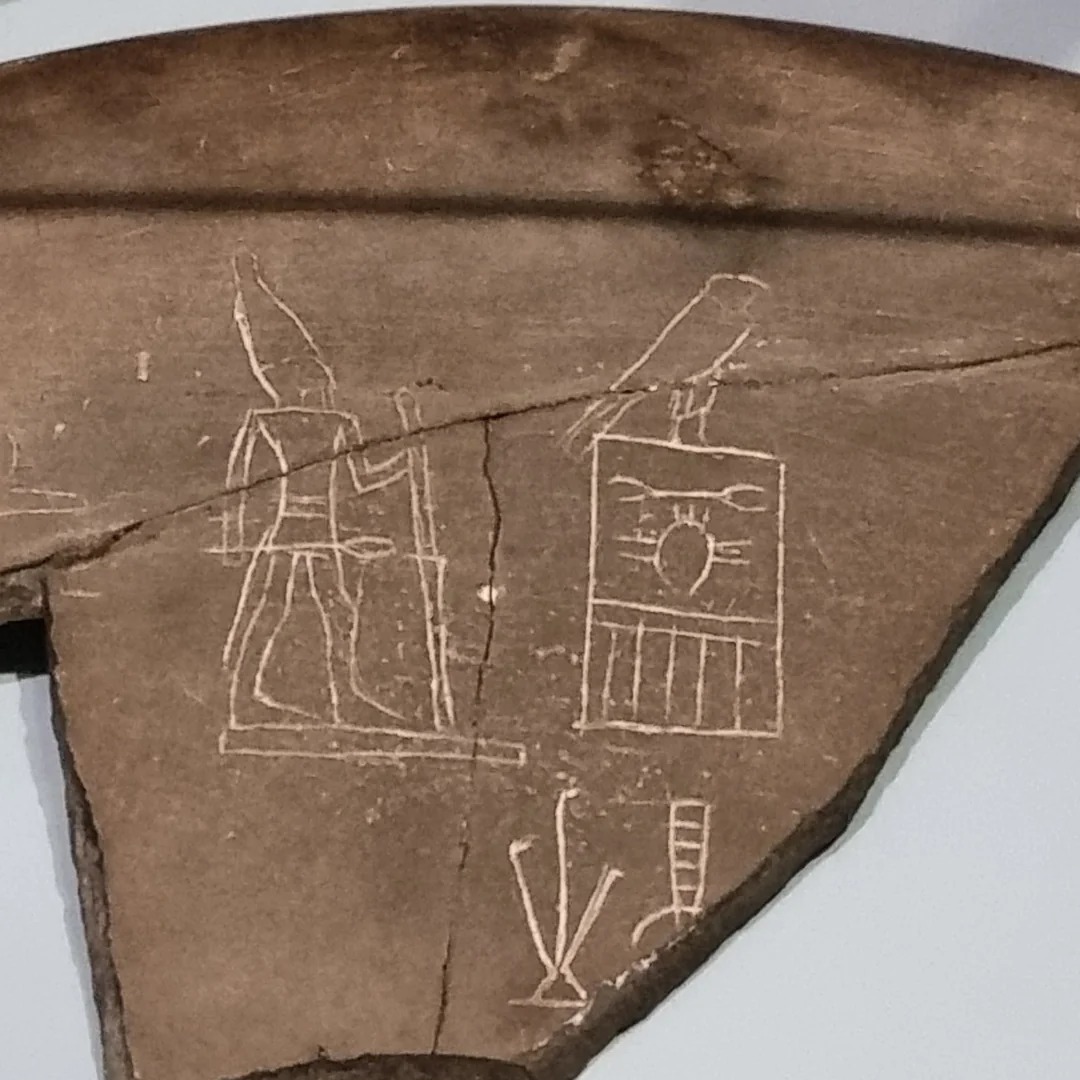
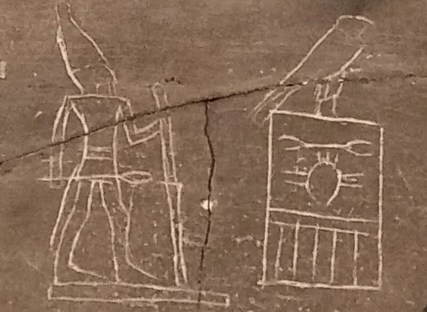
A destra, il nome di Anedjib nell’ormai familiare serekh o facciata di palazzo e, a sinistra, un’immagine di Anedjib che probabilmente impugna una mazza cerimoniale. Il fotografo si fa chiamare Udimu.
He was apparently the William Wallace or Mel Gibson of ancient Egypt as his name means “Brave of heart.” Once again, you can see that same heart in his name (ib) which, as you may remember (from my recent post on Aha and Benerib) was placed on the Scale of Ma’at in the Judgement Hall.
Era apparentemente il William Wallace o Mel Gibson dell’antico Egitto, poiché il suo nome significa “Coraggioso di cuore”. Ancora una volta, si può notare lo stesso cuore nel suo nome (ib) che, come ricorderete (dal mio recente post su Aha e Benerib), era posto sulla Scala di Ma’at nella Sala del Giudizio.
Anedjib’s throne name was “Merbiap” which means he also must have been a king in the Game of Thrones  as Merbiap is translated as “Beloved one of the iron throne.”
Il nome di intronizzazione di Anedjib era “Merbiap”, il che significa che doveva essere un re anche in Game of Thrones poiché Merbiap si traduce come “Amato del trono di ferro”.

During the 10-year reign of Anedjib, the artifact pictured was created in that middle of the 29th Century BCE. It is the most enigmatic such object that I can think of from ancient Egypt. In fact, it is called an “oopart” which is defined as an artifact technologically at odds with its determined age. Yet, its age is determined based on physical, chemical and geological evidence and, most importantly, was found in the tomb of Anedjib’s son named Sabu. The ornamental vessel was found in the burial chamber of the Mastaba of Sabu (Tomb 3111) at Saqqara by Egyptologist Walter Emery on the 10th of January 1936.
Durante il regno decennale di Anedjib, il manufatto raffigurato fu creato a metà del 29° secolo a.C.. È l’oggetto più enigmatico dell’antico Egitto che mi sia venuto in mente. Infatti, è chiamato “oopart”, ovvero un manufatto tecnologicamente in contrasto con l’età che gli è stata attribuita. Tuttavia, la sua età è stata determinata sulla base di prove fisiche, chimiche e geologiche e, soprattutto, è stato trovato nella tomba del figlio di Anedjib, Sabu. Il vassoio ornamentale fu trovato nella camera funeraria della Mastaba di Sabu (Tomba 3111) a Saqqara dall’egittologo Walter Emery il 10 gennaio 1936.
The Tri-Lobed Disc of Sabu is a round-bottomed bowl with three thinly-carved curved lobes. As you can see, the lobes are carved at 120 degrees around its periphery. And the shape and curve of those lobes suggest some sort of function. Akio Kato of Kanagawa University proposes that it was used in making beer while others propose that it was used in manufacturing natron.
Il disco trilobato di Sabu è una ciotola a fondo rotondo con tre lobi curvi e sottili. Come si può vedere, i lobi sono intagliati a 120 gradi intorno alla sua parte terminale. La forma e la curvatura di questi lobi suggeriscono una sorta di funzione. Akio Kato dell’Università di Kanagawa propone che sia stato utilizzato per la produzione di birra, mentre altri propongono che sia stato utilizzato per la produzione di natron.
Its medium is metasiltstone and its diameter is 60 cm or 23.5 inches. I could not determine its accession number but it is found in the Cairo Museum (formerly immediately adjacent to the two coffins of Ahmose-Merytamun). I believe it is still there but the coffins have been moved.
Il suo supporto è la metasiltite e il suo diametro è di 60 cm o 23,5 pollici. Non sono riuscito a determinare il suo numero di inventario. (in passato era vicino ai due sarcofagi di Ahmose-Merytamun). Credo sia ancora lì, ma i due sarcofagi sono stati spostati.
Anedjib’s Great Royal Wife was named Betrest.
La Grande Moglie Reale di Anedjib si chiamava Betrest.
 LA CIVILTA' EGIZIA