
By Dave Robbins
Traduzione in italiano a cura di Patrizia Burlini
Semerkhet was the eighth of nine Dynasty 1 kings of Egypt. As you might recognize by now, Semerkhet was his serekh or Horus name as indicated by the image of Horus perched on top of the palace facade called a serekh by the ancient Egyptians. As you can see in both artifacts pictured, his serekh name was spelled in hieroglyphs as: 𓋴𓍋𓄡 where the folded cloth (𓋴) is the ‘s’ and, like Narmer, the chisel (𓍋) is the ‘mr’ and, finally, the belly and tail (𓄡) is the ‘kh.’ So all, together, it’s ‘s-mr-kh’ and, I confess, I don’t know where the ‘t’ is derived but maybe just to make it easy to pronounce.
Semerkhet era l’ottavo dei nove re della I Dinastia d’Egitto. Come ormai saprete, Semerkhet era il suo serekh o nome di Horus, come indica l’immagine di Horus appollaiato in cima alla facciata del palazzo chiamato serekh dagli antichi Egizi. Come si può vedere in entrambi i manufatti raffigurati, il suo nome serekh era scritto in geroglifici come: 𓋴𓍋𓄡 dove la stoffa ripiegata (𓋴) è la “s” e, come Narmer, lo scalpello (𓍋) è la “mr” e, infine, il ventre e la coda (𓄡) sono la “kh”. Quindi tutti insieme fanno “s-mr-kh” e, lo confesso, non so da dove derivi la “t”, ma forse solo per facilitare la pronuncia.


The stela is in the Cairo Museum standing immediately adjacent to the Stela of Merneith. Pictured second is a sherd found in the Tomb of Qa’a (Tomb U) at Umm el-Qa’ab and now in the Petrie Museum in London. On the sherd, you see a slightly different spelling where the final hieroglyph, often called a sieve (𓐍), is also a ‘kh.’
La stele si trova al Museo del Cairo, immediatamente adiacente alla Stele di Merneith. La seconda immagine è un coccio trovato nella Tomba di Qa’a (Tomba U) a Umm el-Qa’ab e ora al Petrie Museum di Londra. Sul coccio si nota una grafia leggermente diversa in cui il geroglifico finale, spesso chiamato setaccio (𓐍), è anche una “kh”.
As recorded on a fragment of the Palermo Stone, Semerkhet had an 8.5-year reign. The Palermo Stone, along with Manetho and Eusebius, record a great calamity in his first year as king but nothing appears to be known about the nature of the calamity. It is thought though that the calamity made his reign quite unsuccessful.
Come riportato su un frammento della Pietra di Palermo, Semerkhet ebbe un regno di 8,5 anni. La Pietra di Palermo, insieme a Manetone ed Eusebio, riporta una grande calamità nel suo primo anno di regno, ma nulla sembra essere noto sulla natura della calamità. Si pensa però che la calamità abbia reso il suo regno piuttosto fallimentare.
The stela has the accession number of CG 14633 in the Cairo Museum and the sherd has the accession number of UC.36756 in London’s Petrie Museum.
La stele ha il numero di accesso CG 14633 nel Museo del Cairo e il frammento ha il numero di accesso UC.36756 nel Petrie Museum di Londra.
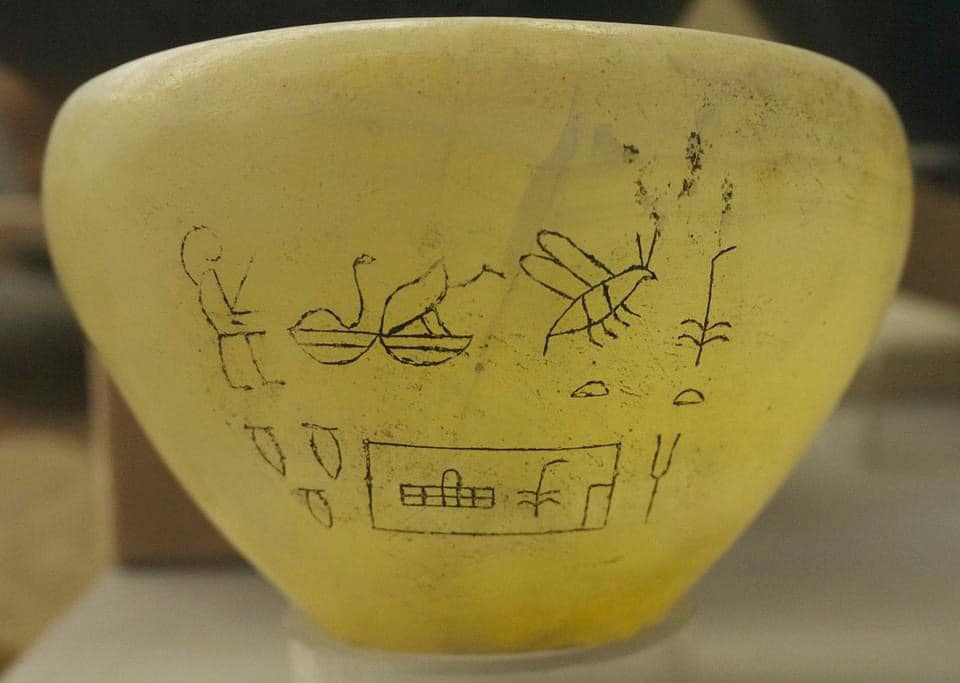
La coppa di alabastro del Museo Archeologico Nazionale di Parigi mostra il nome del trono di Semerkhet, che era “Iry”. L’intera iscrizione è tradotta come “Il re doppio che appartiene alle Due Signore”, dove le Due Signore si riferiscono al cobra e all’avvoltoio raffigurati al centro o alle due dee chiamate Wadjet e Nekhbet (indicate al contrario nei geroglifici Unicode come 𓅒). Il fotografo si fa chiamare “Iry-Hor” che è il nome di un sovrano predinastico egizio!
 LA CIVILTA' EGIZIA