By Dave Robbins
Traduzione in italiano a cura di Patrizia Burlini
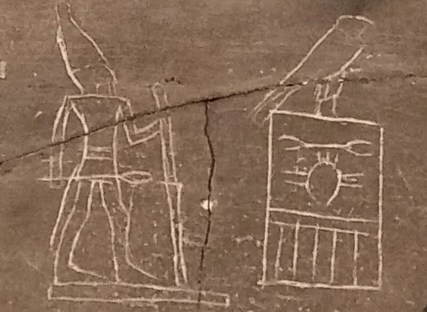
We now reach the ninth and final king of Dynasty I … that being King Qa’a which was both his serekh or Horus name and his throne name. His predecessor, Semerkhet, was the first to use a Nebty name, but my photo from the Cairo Museum (despite the use of the Two Ladies immediately above his name) is his throne name according to https://pharaoh.se/pharaoh/Qaa
Arriviamo ora al nono e ultimo re della dinastia I… ovvero il re Qa’a, che era sia il suo serekh o nome di Horus sia il suo nome di intronizzazione. Il suo predecessore, Semerkhet, fu il primo a usare un nome Nebty, ma la mia foto del Museo del Cairo (nonostante l’uso delle Due Signore immediatamente sopra il suo nome) è il suo nome di intronizzazione secondo https://pharaoh.se/pharaoh/Qaa.

Thus, his throne name appears in the top left of his Royal Label as: 𓅒𓆤𓏏 𓇓 𓏏 𓈎 𓂝 which, according to pharaoh.se, translates as “The Dual king with raised arm of the Two Ladies.” But the last two hieroglyphs 𓈎 (Q) and 𓂝 (the ayin … often used as a vowel … would be the ‘a’). Remember that there were no vowels in hieroglyphs. We just use glottal stops (the alef, the ayin, the yod) as convenient vowels or we probably would have a difficult time pronouncing many of their names. At least, this is how I understand it. I would enter the actual transliterations but most browsers are still incapable of displaying them other than as boxes (meaning they could not be displayed).
Pertanto, il suo nome di intronizzazione appare in alto a sinistra della sua placca reale come: 𓅒𓆤𓏏 𓇓 𓏏 𓈎 𓂝 che, secondo pharaoh.se, si traduce come “Il duplice sovrano con il braccio alzato delle due signore”. Ma gli ultimi due geroglifici 𓈎 (Q) e 𓂝 (l’ayin… spesso usato come vocale… sarebbe la ‘a’). Ricordiamo che nei geroglifici non esistevano vocali. Noi usiamo solo gli stop glottali (l’alef, l’ayin, lo yod) come comode vocali, altrimenti probabilmente avremmo difficoltà a pronunciare molti dei loro nomi. Almeno, questo è il modo in cui lo intendo io. Vorrei inserire le traslitterazioni vere e proprie, ma la maggior parte dei browser non è ancora in grado di visualizzarle se non come caselle (il che significa che non possono essere visualizzate).
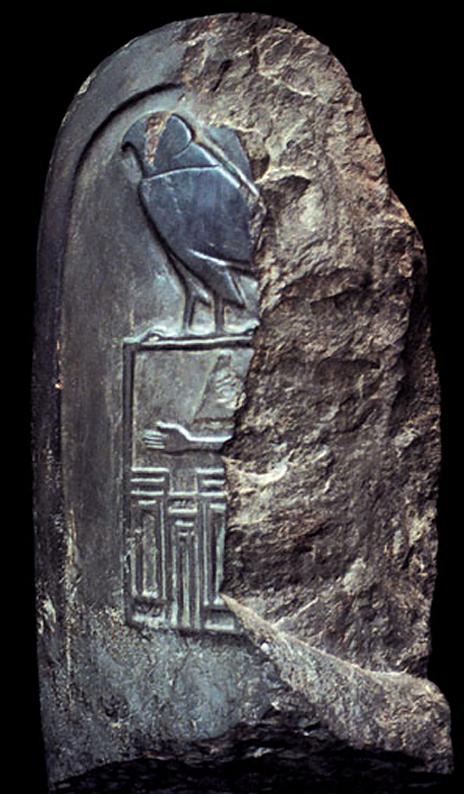
Stele di Qa’a ora nel NMEC. Purtroppo non ho il nome del fotografo.
Qa’a was not just the last king of Dynasty 1 but also the last king of the 29th Century BCE. He is generally given a reign of 33 years because we know that he celebrated a second heb festival and since the first was generally celebrated in a king’s 30th year and the second heb was three years later, he likely achieved 33 years. It is thought that, upon his death, an internal war erupted between two possible successors. Yet neither of them succeeded him and his reign was followed by the founder of Dynasty 2.
Qa’a non fu solo l’ultimo re della Dinastia 1, ma anche l’ultimo sovrano del 29° secolo a.C.. In genere gli si attribuisce un regno di 33 anni perché sappiamo che celebrò una seconda festa di Heb e, poiché la prima veniva generalmente celebrata nel 30° anno di vita di un re e la seconda Heb era tre anni dopo, è probabile che abbia raggiunto i 33 anni. Si pensa che, alla sua morte, sia scoppiata una guerra interna tra due possibili successori. Tuttavia, nessuno dei due gli succedette e il suo regno fu seguito dal fondatore della Dinastia 2.
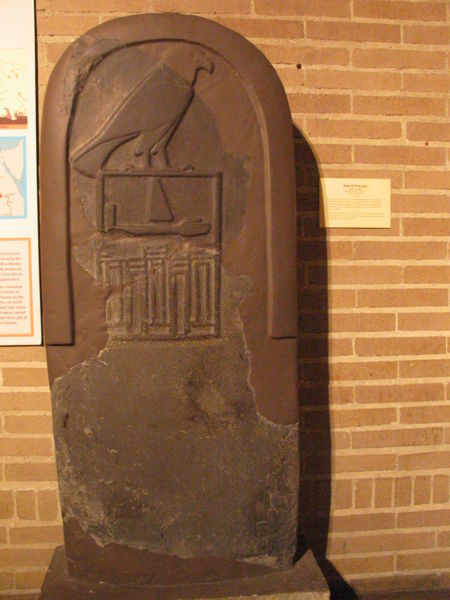
Stele di Qa’a nel Penn Museum. Il fotografo si chiama Chipdawes. La licenza è Creative Commons.

La tomba di Qa’a a Umm el-Qa’ab. Il fotografo è Tore Kjeilen, che ha dichiarato che la foto è di dominio pubblico.
 LA CIVILTA' EGIZIA