
By Dave Robbins
Traduzione in italiano a cura di Patrizia Burlini
Today, I will begin a long series of posts on each Egyptian pharaoh, that is, one by one through each of the kings in which I have photographed statues, wall-relief images or artifacts of said king. Of course, since there are said to be 170 such pharaohs (and my own list contains 189 (not including Predynastic kings or Roman Emperors), I won’t have anything for some, maybe many? pharaohs, of course, but I’ll remember to mention them.
“Oggi inizierò una lunga serie di post su ogni faraone egiziano, cioè uno per uno attraverso ciascuno dei re di cui ho fotografato statue, immagini murali o manufatti. Naturalmente, poiché si dice che ci siano 170 faraoni di questo tipo (e il mio elenco ne contiene 189, senza contare i re predinastici e gli imperatori romani), non avrò nulla per alcuni, forse molti, faraoni, ma mi ricorderò di menzionarli.
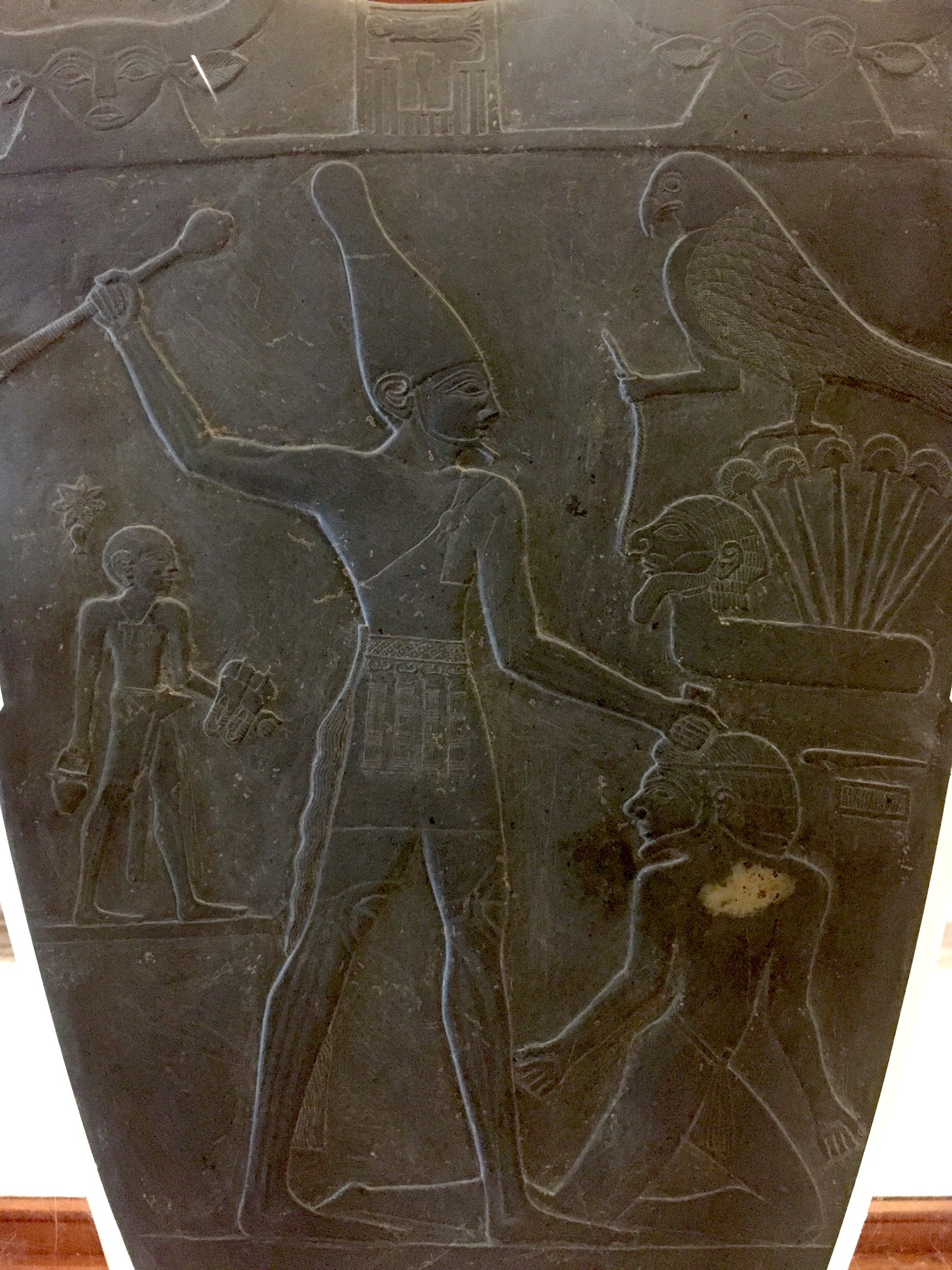
Everybody knows this first one, that is, Narmer, and his Palette, found in 1898 at the ‘main deposit’ in Hierakonpolis by James Quibell. As you can see, Narmer is wearing the white crown of upper Egypt called the hedjet ( 𓌉𓏏 𓋑 ) which, itself, just means the color white. In fact, in this literally 5000-year-old artifact, we can see the start of one of the longest lasting cultural traditions we’ve ever known in human civilization. That is, the smiting motif, where Narmer is about to clobber his captive (held by the hair in his left hand) with the mace held in his right hand. Other traditions started with this image include the false beard, the chin strap, the kilt, and the bull’s tail … all worn by Egyptian kings for the next 30 centuries.
Il primo lo conoscono tutti: Narmer e la sua Tavolozza, ritrovata nel 1898 nel “deposito principale” di Hierakonpolis da James Quibell. Come si può vedere, Narmer indossa la corona bianca dell’alto Egitto chiamata hedjet ( 𓌉𓏏 𓋑 ) che, di per sé, significa semplicemente il colore bianco. In effetti, in questo manufatto risalente letteralmente a 5000 anni fa, possiamo vedere l’inizio di una delle tradizioni culturali più longeve che abbiamo mai conosciuto nella civiltà umana. Si tratta del motivo della bastonatura (colpire il nemico n.d.T) , in cui Narmer sta per colpire il suo prigioniero (tenuto per i capelli con la mano sinistra) con la mazza tenuta nella mano destra. Altre tradizioni nate da questa immagine sono la barba posticcia, la mentoniera, il gonnellino e la coda di toro… tutti indossati dai re egizi nei 30 secoli successivi.

La collocazione nell’atrio del Museo Egizio … piano terra, galleria 43 … a meno di dieci secondi dall’ingresso del museo.
© Dave Robbins
How do we know Narmer’s name? Just above the very tip of his crown are his name’s hieroglyphs. “Nar” is a catfish represented by the hieroglyph K24 (which I can only substitute for with K8, that is, 𓆢, along with U23 or 𓍋 i.e. ‘mr’ which represents a chisel shown vertically. So his name, Narmer, was spelled: 𓆢 𓍋 (i.e. nr-mr). Enclosing the two hieroglyphs is a palace facade. The facade itself (𓊁) became part of the Horus name or serekh name of the fivefold royal titulary. Thus, we know Narmer’s serekh name is, of course, Narmer. What do you suspect would be his ‘throne name?’
Come conosciamo il nome di Narmer? Proprio sopra la punta della sua corona si trovano i geroglifici del suo nome. “Nar” è un pesce gatto rappresentato dal geroglifico K24 (che posso sostituire solo con K8, cioè 𓆢, insieme a U23 o 𓍋, cioè ‘mr’, che rappresenta uno scalpello in verticale. Quindi il suo nome, Narmer, era scritto: 𓆢 𓍋 (cioè nr-mr). I due geroglifici sono circondati dalla facciata di un palazzo. La facciata stessa (𓊁) divenne parte del nome di Horus o serekh del quintuplice titolo reale. Quindi, sappiamo che il nome serekh di Narmer è, ovviamente, Narmer. Quale pensate che sia il suo “nome di intronizzazione”?
In front of Narmer’s face on this thought-to-be ‘recto’ side of the palette is a falcon holding yet another captive with a nose ring. The six papyrus plants under the falcon may be hieroglyphs for 6000 (𓇀𓆼) which it is speculated may be the number of prisoners captured.
Davanti al volto di Narmer, su questo lato ritenuto “recto” della tavolozza, c’è un falco che tiene un altro prigioniero con un anello al naso. Le sei piante di papiro sotto il falco potrebbero essere geroglifici per 6000 (𓇀𓆼), che si ipotizza possano essere il numero di prigionieri catturati.
Behind Narmer, also on the battlefield, is his sandal-bearer who carries, of course, royal sandals in his left hand and, likely, a pot of water in his right hand. The goddess Bat is found in each upper corner. Bat, an important influence on the cult of Hathor, is thought to mean “female spirit.”
Dietro Narmer, sempre sul campo di battaglia, c’è il suo portatore di sandali che porta, ovviamente, i sandali reali nella mano sinistra e, probabilmente, un vaso con dell’acqua nella mano destra. La dea Bat si trova in ogni angolo superiore. Bat, un’importante influenza sul culto di Hathor, si pensa che significhi “spirito femminile”.
As mentioned, this, of course, is just the recto side of the palette. The accession number in the Cairo Museum is CG 14716. My photo is from February 2018 when, believe it or not, Janet and I went to the Egyptian Museum in Cairo, everyday for five consecutive days.  Not kidding.
Come già detto, questo è solo il lato recto della tavolozza. Spero di avere una foto decente del verso, che posterò nei commenti. Il numero di accesso al Museo del Cairo è CG 14716. La mia foto risale al febbraio 2018 quando, che ci crediate o no, Janet e io siamo andati al Museo Egizio del Cairo, tutti i giorni per cinque giorni consecutivi. Non sto scherzando.”

La metà superiore del “verso” della Paletta di Narmer. Non spiegherò tutto di questo lato, ma su di esso Narmer indossa la corona rossa del basso Egitto chiamata “deshret”, rappresentata dal geroglifico 𓋔 e, come si può vedere, contiene una spirale che rappresenta la lingua o proboscide parzialmente estesa di un’ape. L’ape mellifera era un simbolo del basso Egitto e faceva persino parte del nome di un re, detto bity ovvero: 𓆤 𓏏𓀰
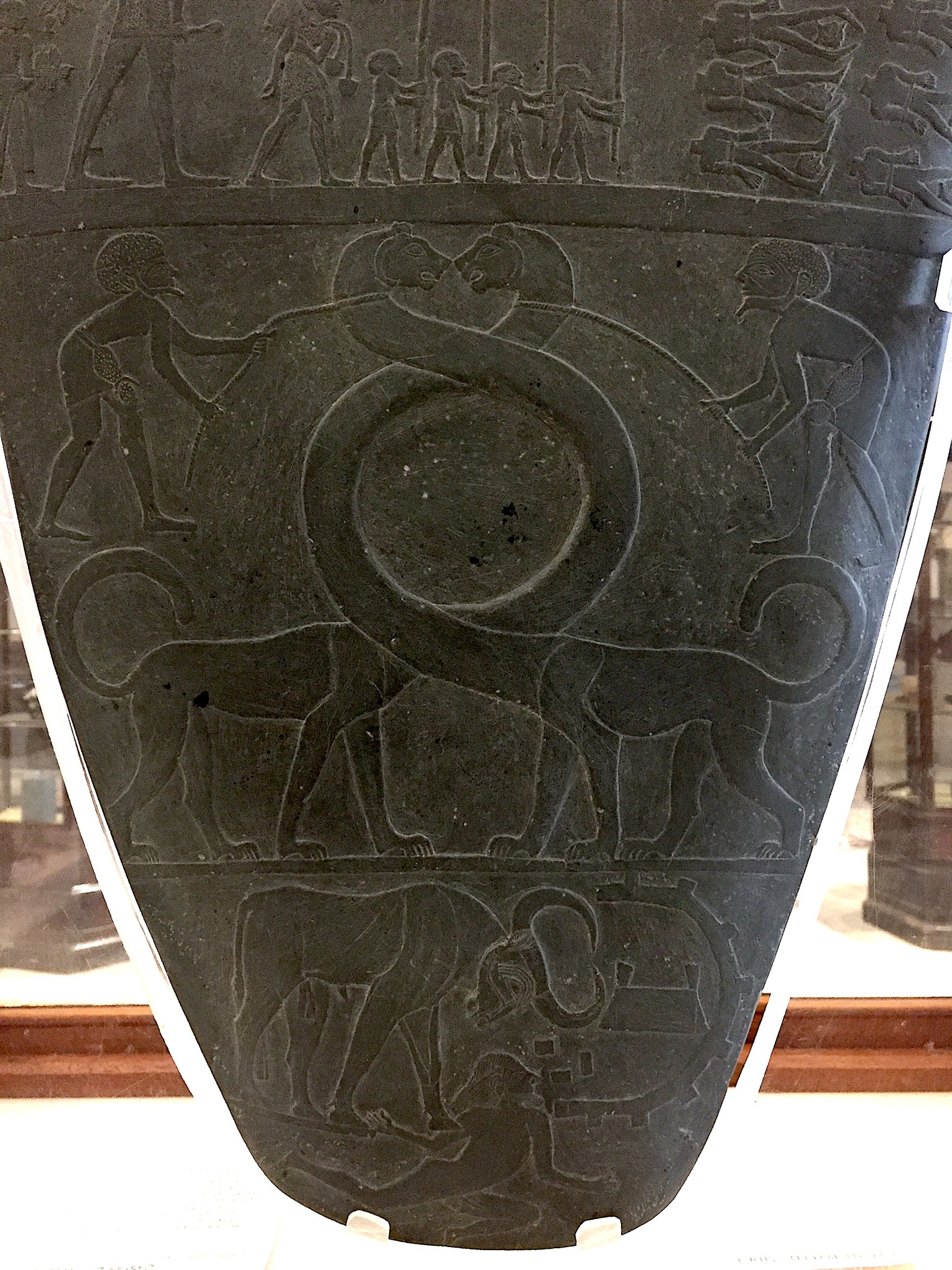
La metà inferiore del verso. Questo lato era davvero il “verso”? In realtà non lo sappiamo, ma è ciò che si pensa comunemente.
 LA CIVILTA' EGIZIA