Pictures

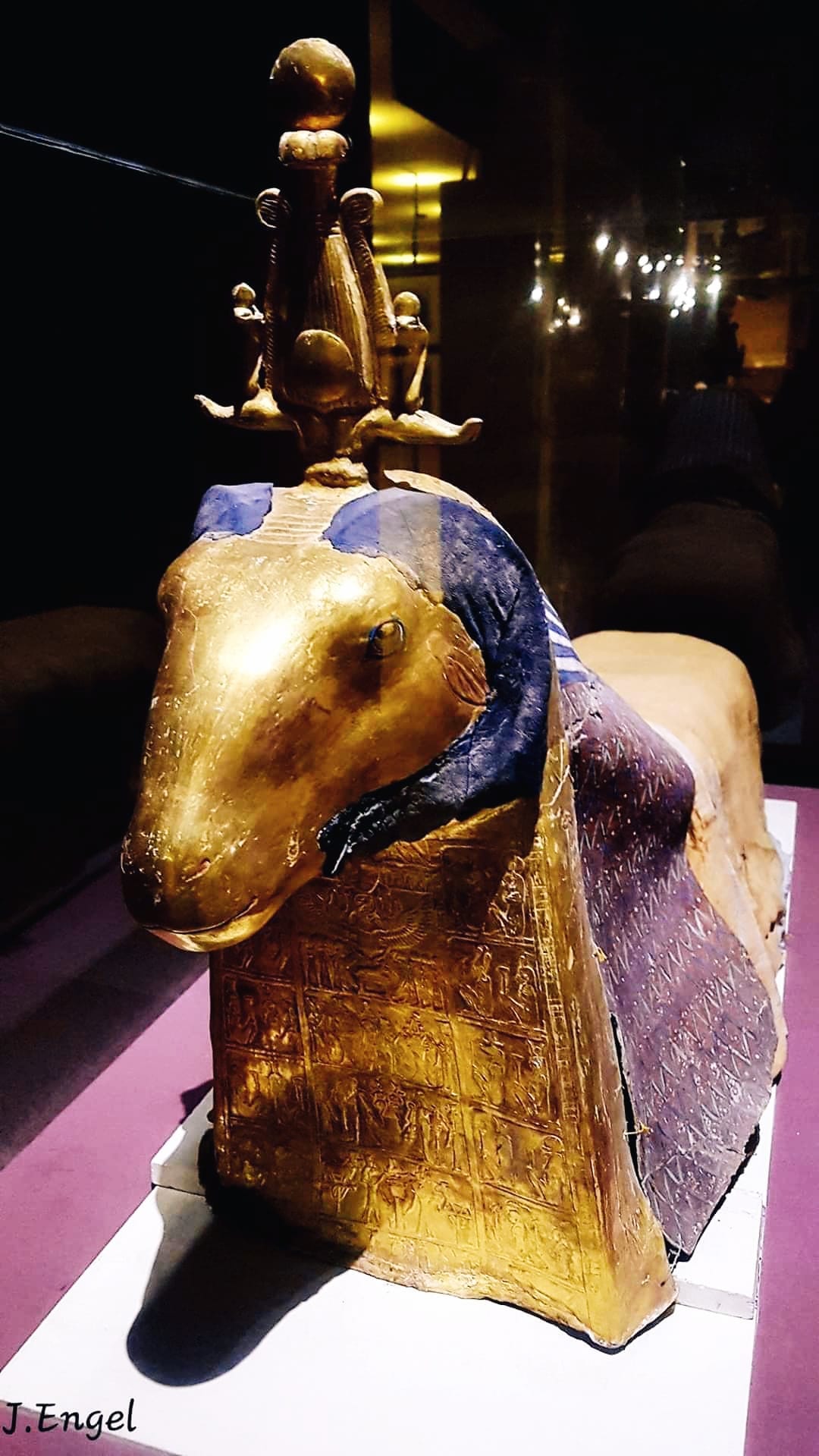
Mummy of the ram with gilded cartonage

By Jacqueline Engel

Mummy of the ram with gilded cartonage.

The ram mentioned to Khnum.

The principle god of the Triad of Elephantine.

Ptolemaie period

Elephantine.

Nubian museum Aswan.

The Triad of Elephantine

Elephantine (Abu) was the ancient capital of the first nome of Upper Egypt.

It is a small island just north of the First Cataract of the Nile.

Khnemu was a ram-headed creator-god whose cult center was at the city of Elephantine.

Khnemu was said to have created all men and their kai from clay and straw.

He molded their bodies on a giant potter’s wheel.

In the Pyramid Texts of the Old Kingdom, the pharaoh was called the “son of Khnemu.”

Inscriptions at Elephantine detail the visit to the shrine of Khnemu at Elephantine by Pharaoh Djoser.

He was there to request the god’s help in ending a seven year long famine which had plagued Egypt.

At the Great Temple of Luxor, Khnemu was shown sculpting the body and ka of the pharaoh.

The queen had conceived the king following intercourse with Amon and Hathor brought the sculptures to life by giving them the ankh.

Rounding out the triad of Elephantine was Khnemu’s consort, Satet and their daughter, Anqet.

Satet, as the “Mistress of Elephantine”, was associated with the annual flooding of the Nile.

Anqet was the divine child of Satet and Khnemu and was seen as the guardian of Egypt’s southern frontier and the Nile cataracts.
Back to Jacqueline’s pictures

Pictures

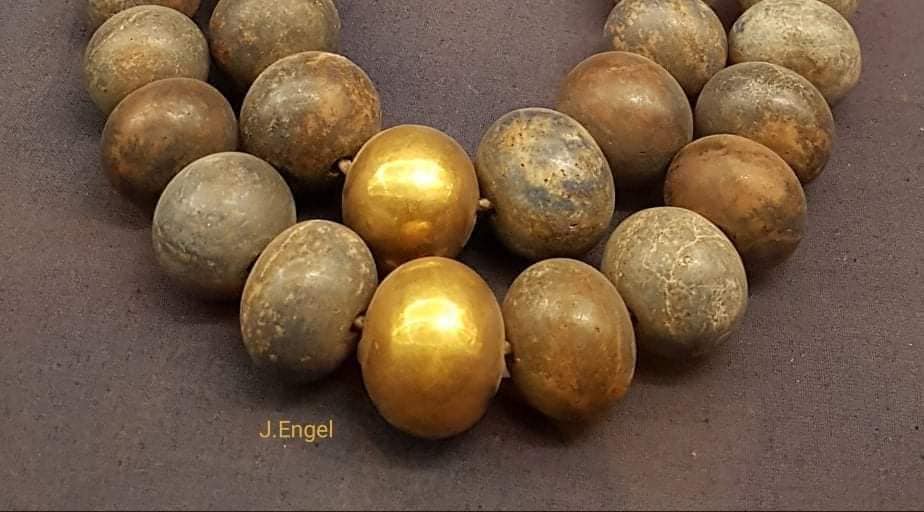
Necklace from Psusennes I’s tomb

By Jacqueline Engel

Tanis Treasures

Royal riches discovered during World War II rival those of Tutankhamun, but remain virtually unknown.

In the late 1930s and early 1940s, an entire complex of royal tombs was found intact at Tanis, yielding four gold masks, solid silver coffins, and spectacular jewelry, some even once worn by a pharaoh mentioned in the Bible. The treasures are one of the greatest archaeological discoveries of all time.

The Twenty-first Dynasty of Egypt is usually classified as the first Dynasty of the Ancient Egyptian Third Intermediate Period, lasting from 1069 BC to 945 BC.

Necklace from Psusennes I’s tomb with beads of lapis-lazuli.

Egyptian Museum Caïro

Back to Jacqueline’s pictures

Pictures

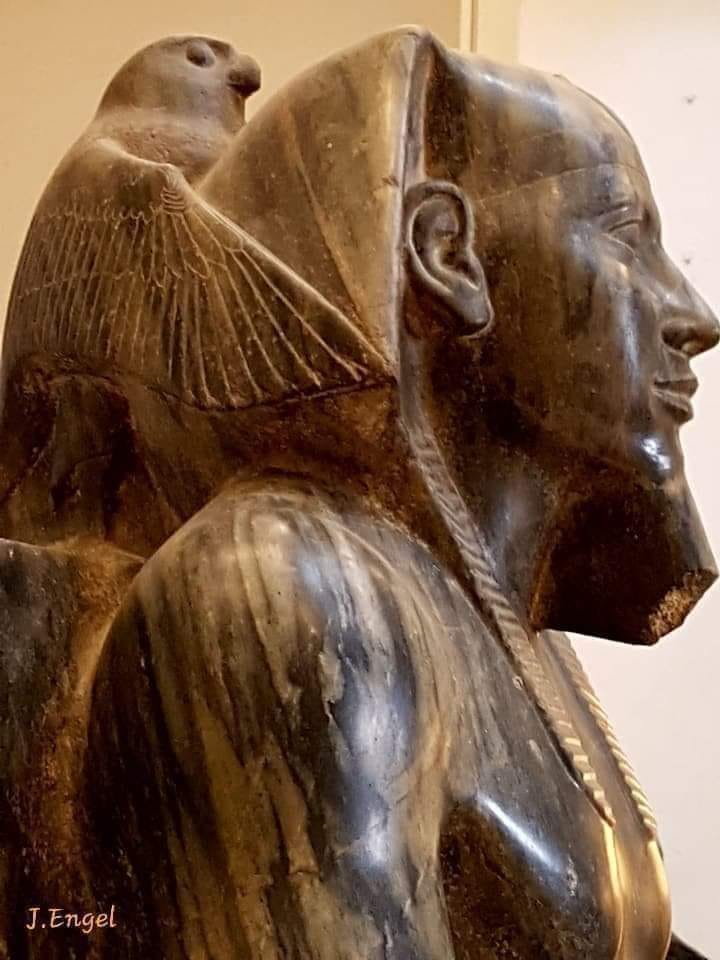
Diorite statue of King Chephren (Khafre)

By Jacqueline Engel

Builder of the second pyramid.

Its remarkable state of preservation, its grandeur and the motif of the hawk, emblematical of his mythological ancestors, protecting his head with her outstretched wings, all combine to rank it first in the statuary of ancient Egypt.

It was found at the bottom of a wall near the gateway of his valley-temple ‘the temple of the sphinx’. Giza.

Khafra (also read as Khafre, Khefren and Chephren) was an ancient Egyptian king (pharaoh) of 4th dynasty during the Old Kingdom. He was the son of Khufu and the throne successor of Djedefre. According to the ancient historian Manetho, Khafra was followed by king Bikheris, but according to archaeological evidences he was rather followed by king Menkaure. Khafra was the builder of the second largest pyramid of Giza. The view held by modern Egyptology at large remains that the Great Sphinx was built in approximately 2500 BC for Khafra.[2] There is not much known about Khafra, except the historical reports of Herodotus, who describes him as a cruel and heretic ruler, who kept the Egyptian temples closed after Khufu had sealed the

Egyptian Museum Caïro

Back to Jacqueline’s pictures

Pictures

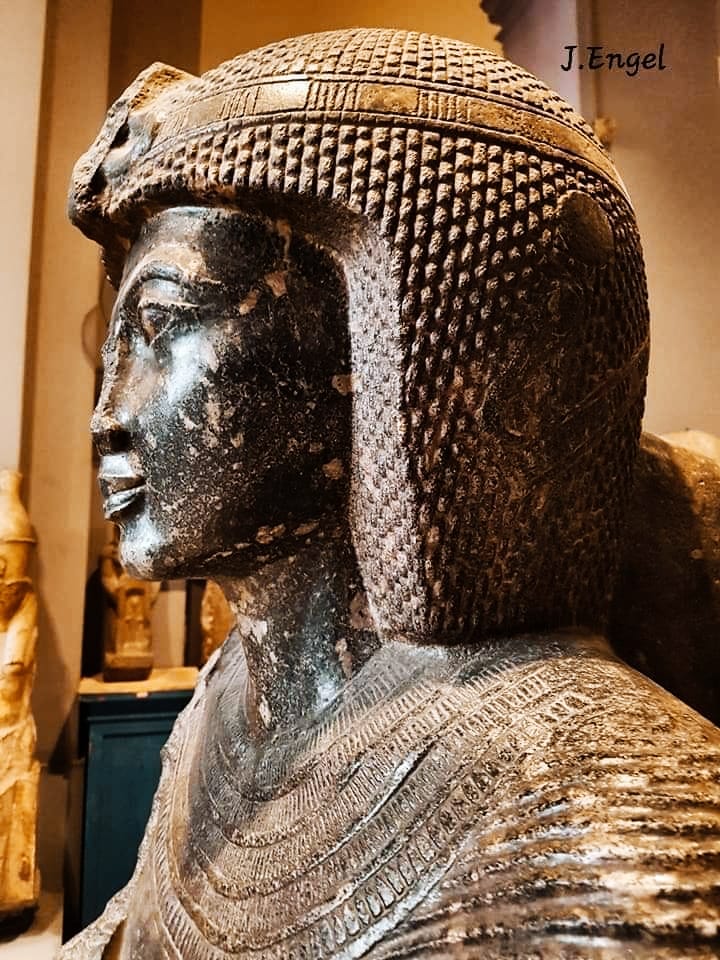
Mutnodjmet

By Jacqueline Engel

Mutnodjmet.

The wife of Nahktmin.
Egyptian Museum Caïro.

Nakhtmin (also Minnakht) held the position of generalissimo during the reign of pharaohTutankhamun of the Eighteenth Dynasty of Ancient Egypt.


His titles during the reign of Tutankhamun included “the true servant who is beneficial to his lord, the king’s scribe,” “the servant beloved of his lord,” “the Fan-bearer on the Right Side of the King,” and “the servant who causes to live the name of his lord.”


These titles were found on five ushabtis that Nakhtmin offered as funerary presents for pharaoh Tutankhamun

Back to Jacqueline’s pictures

Pictures

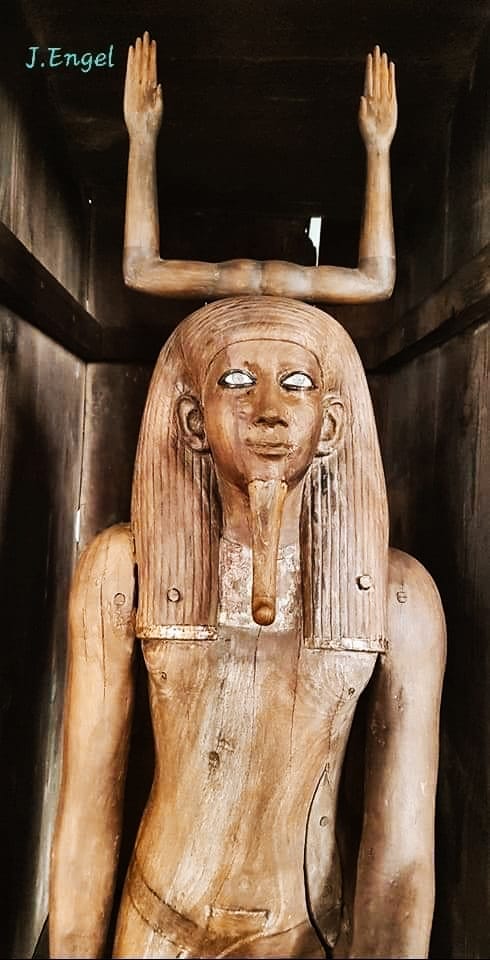
King Hor

By Jacqueline Engel

King Hor.
(also know as Awybre)

Egyptian king of the 13th Dynasty. His reign was short (seven months).

Photo: Ka statue found in his tomb.

Egyptian Museum Caïro.

This wooden structure is a magnificent, well-preserved masterpiece.
It depicts the Ka statue of King Hor I /Au-ib-Re, which is clearly marked by the Ka hieroglyphic sign as two upraised arms topping the head. The Ka, or guardian spirit, had to survive in the statue to keep its owner alive.

The statue, found within its accompanying naos, or shrine, was covered with a fine layer of painted stucco. The king is sculpted wearing a three-part long wig, leaving the ears exposed. He wears a long, curved divine beard.

It is noteworthy that the sculptor successfully modeled the inlaid eyes to lend a lifelike appearance to this expressive face. The eyes are inlaid with rock crystal and quartz.

It seems that the Ka statue once held a scepter in its right hand and a staff in its left hand. The statue of the king was fixed to a wooden panel that could be taken out of the naos

Back to Jacqueline’s pictures

Pictures

Seti I statue

By Jacqueline Engel

Seti I.
1294-1279BC.
Abydos.

Egyptian Museum Caïro.

Menmaatre Seti I (or Sethos I as in Greek) was a pharaoh of the New Kingdom Nineteenth Dynasty of Egypt, the son of Ramesses I and Sitre, and the father of Ramesses II.
As with all dates in Ancient Egypt, the actual dates of his reign are unclear, and various historians claim different dates, with 1294 BC to 1279 BC and 1290 BC to 1279 BC being the most commonly used by scholars today.

Back to Jacqueline’s pictures

Pictures

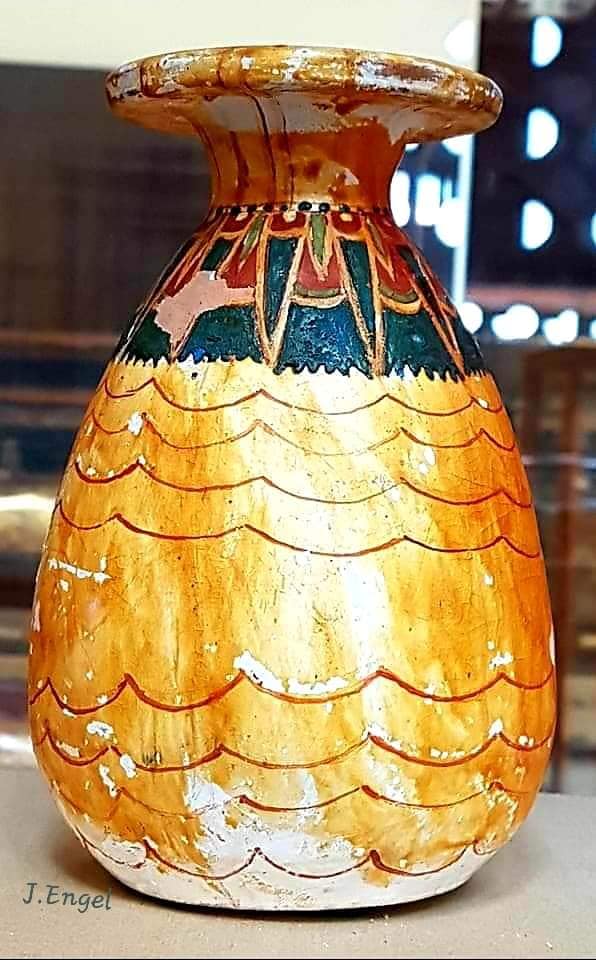
Dummy vases

By Jacqueline Engel

Dummy vases.

Wooden and pottery dummy vases, painted in imitation of stones.

For funarary use.

Yuya and Tuya treasure.

KV 46

(circa 1390 BC).

18th Dynasty

Egyptian Museum Caïro.

Back to Jacqueline’s pictures

Pictures

Ushebti of the vizier Ptahmose

By Jacqueline Engel

Faience.

Found in Abydos

18th dynasty.

Egyptian Museum Cairo

Ptahmose was a High Priest of Amun and Vizier of southern Egypt-(Upper Egypt), under Amenhotep III (18th Dynasty).

Certain historians place him at the end of the reign in 1378 BC. Others place him in the first part of the reign.

Back to Jacqueline’s pictures