By Jacqueline Engel
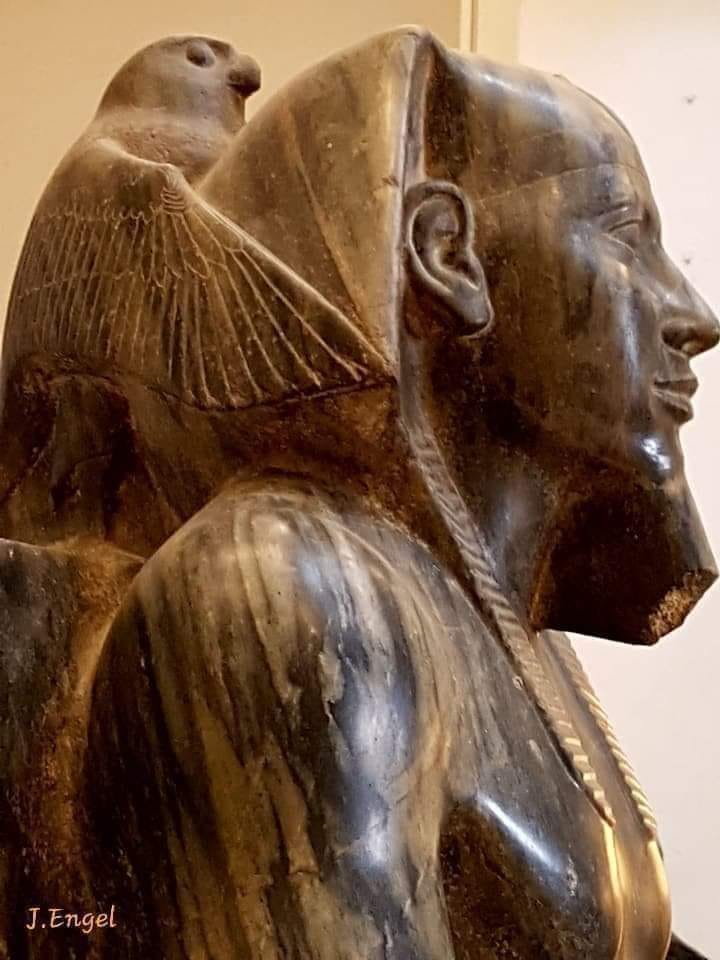
Builder of the second pyramid.
Its remarkable state of preservation, its grandeur and the motif of the hawk, emblematical of his mythological ancestors, protecting his head with her outstretched wings, all combine to rank it first in the statuary of ancient Egypt.
It was found at the bottom of a wall near the gateway of his valley-temple ‘the temple of the sphinx’. Giza.
Khafra (also read as Khafre, Khefren and Chephren) was an ancient Egyptian king (pharaoh) of 4th dynasty during the Old Kingdom. He was the son of Khufu and the throne successor of Djedefre. According to the ancient historian Manetho, Khafra was followed by king Bikheris, but according to archaeological evidences he was rather followed by king Menkaure. Khafra was the builder of the second largest pyramid of Giza. The view held by modern Egyptology at large remains that the Great Sphinx was built in approximately 2500 BC for Khafra.[2] There is not much known about Khafra, except the historical reports of Herodotus, who describes him as a cruel and heretic ruler, who kept the Egyptian temples closed after Khufu had sealed the
Egyptian Museum Caïro
 LA CIVILTA' EGIZIA