Pictures

Wildlife in the ancient marshes

By Jacqueline Engel

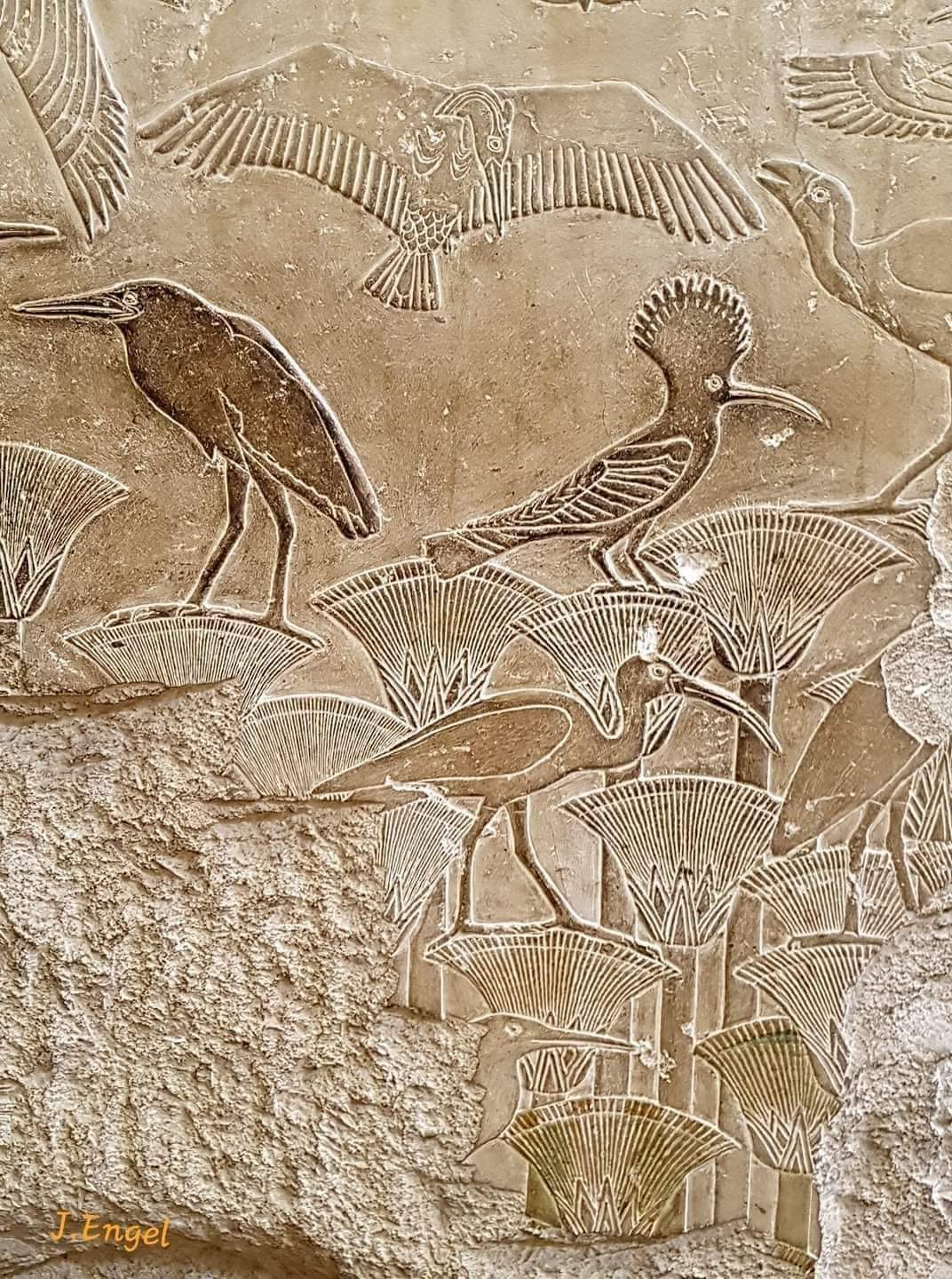
This panel, carved in bas relief, comes from the mortuary temple of Userkaf (2494-2487, first ruler of the 5th Dynasty), which is at Saqqara.

It shows a flock of birds and a butterfly(not in the picture) in a papyrus thicket.

A pied kingfisher hovers above, waiting for fish to appear, while a hoopoe, scared ibis, night heron and a purple gallinule balance the papyrus umbels.

Egyptian Museum Caïro.

Back to Jacqueline’s pictures

Pictures

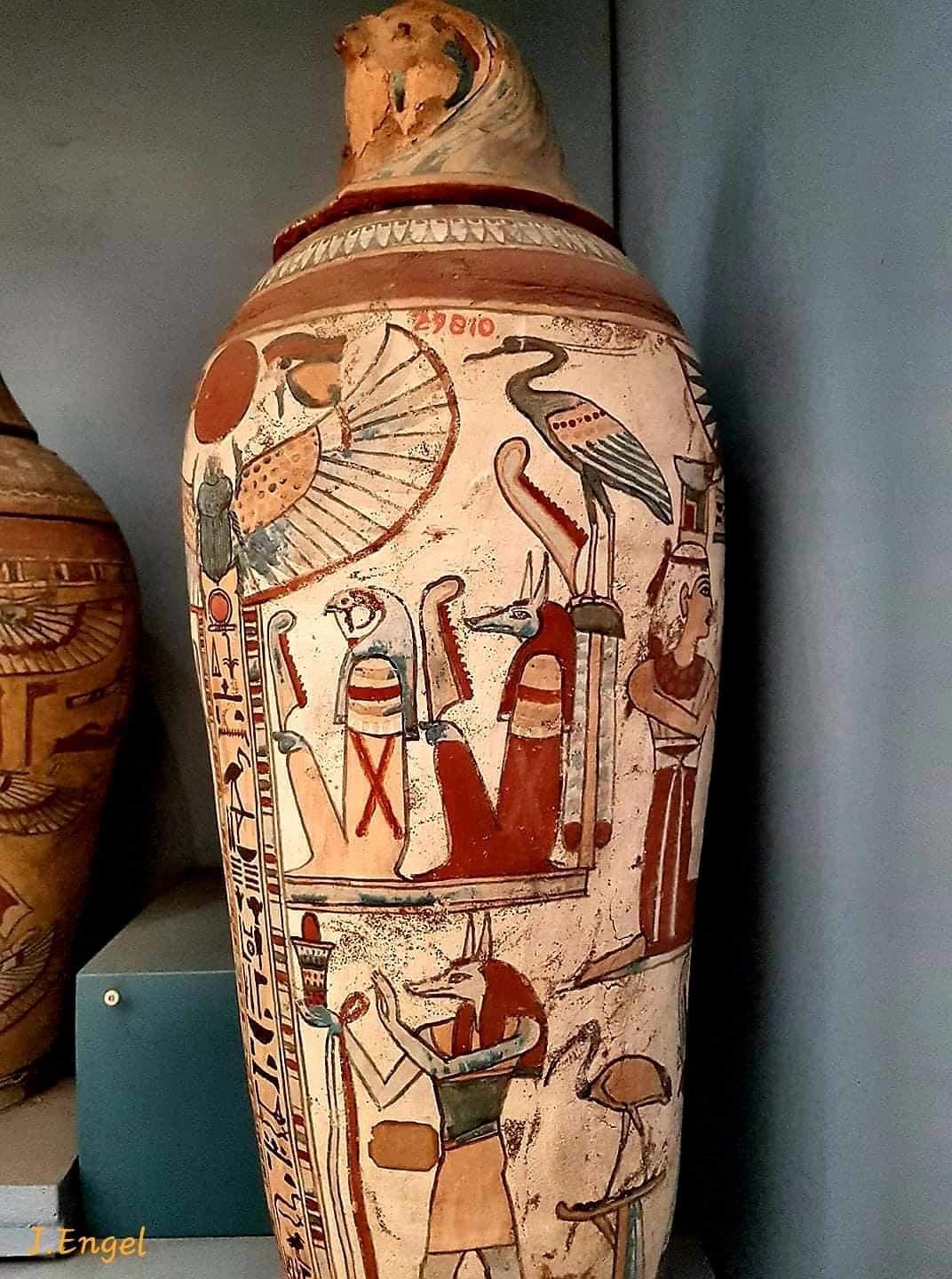
Votive mummy in a jar

By Jacqueline Engel

Late Period

Abydos Shunet el- Zebib.

These Nile silt pottery vessels resemble large elongated canopic jars.

Pictured on the vessels are different divinities and genies, including winged disks and the deities Osiris, Anubis, Thoth, Maat and Horus.

The jars did not always contain entire mummies; often they held feathers and bone fragments from diverse birds.

Egyptian Museum Caïro

Back to Jacqueline’s pictures

Pictures

Child’s coffin

By Jacqueline Engel

Child’s coffin found at Deir el Medina

Wood formerly partially stuccoed, gilded and encrusted with faience and fine stones ; bitumen or resin or pitch.

Length: 105 cm ; width : 33 cm;

height: 38 cm (at face level)

Deir el-Medina, clearing at mid-slope of the western cemetery.

18th dynasty, reigns of Thoutmosis IV and/or Amenhotep III

Egyptian Museum Caïro

Back to Jacqueline’s pictures

Pictures

Statuette of King Senusret I

By Jacqueline Engel

Statuette of King Senusret I or Sesostris I (r. 1971-1926 B.C.), from a private tomb near the Pyramid of Senusret I at El-Lisht, Middle Kingdom .

Painted cedarwood with gesso.

Egyptian Museum Caïro.

Back to Jacqueline’s pictures

Pictures

Seated ka-statue of King Djoser

By Jacqueline Engel

This is the oldest known life-size Egyptian statue and represents King Djoser.

It was found in 1925 in a sealed chamber, known as the serdab (cellar in Arabic), attached to the northern face of the Step Pyramid, near his cult temple within his funerary complex.

As typical of this period, the hole in the serdab allowed the king’s soul (ka) residing in the statue to peer out, receive the offerings, and follow the rituals performed for him.

In addition, in this case, the gaze of the king was turned towards the northern sky, thus pairing him with the Imperishable Stars that never set below the horizon.

Currently a plaster copy has been placed in the serdab where this statue was found.

3rd Dynasty King Netjerikhet Djoser), about 2649-2630 BC.

Saqqara (pyramid complex of Djoser, sendab courtyard),

limestone, pigment, JE 49158

Egyptian Museum Caïro

Back to Jacqueline’s pictures
Pictures

Two Osiride Figures of Tutankhamun

By Jacqueline Engel

These two figures discovered among eleven similar figures buried beneath the floor of a courtyard at Karnak.

Each represents an Amarna period king in a nemes head cloth and kilt, holding the crook and flail crossed on his chest.

These statues illustrate an important moment in Egyptian history: After Akhenaten’s death, Tutankhamon, most likely with the encouragement of his advisors Ay and Herembeb, turned the country back to the worship of Amun.

As part of his building program at Karnak, Akhenaten had erected a series of human-headed sphinxes in his own and his great queen Nefertiti’s likeness along the processional way from the Amin Precinct to the adjoining Mut Precinct.

When he came back to Thebes, Tutankhamun had the head of each sphinx re-carved as a ram, the sacred animal of Amon.

These figures stoud beneath the chins of these criosphinxes, showing the king under the protection of the god.

Quartzite or sandstone,

New Kingdom, 18th Dynasty,

Reign of Tutankhamun,

Karnak Cachet CC 2107-10

Back to Jacqueline’s pictures

Pictures

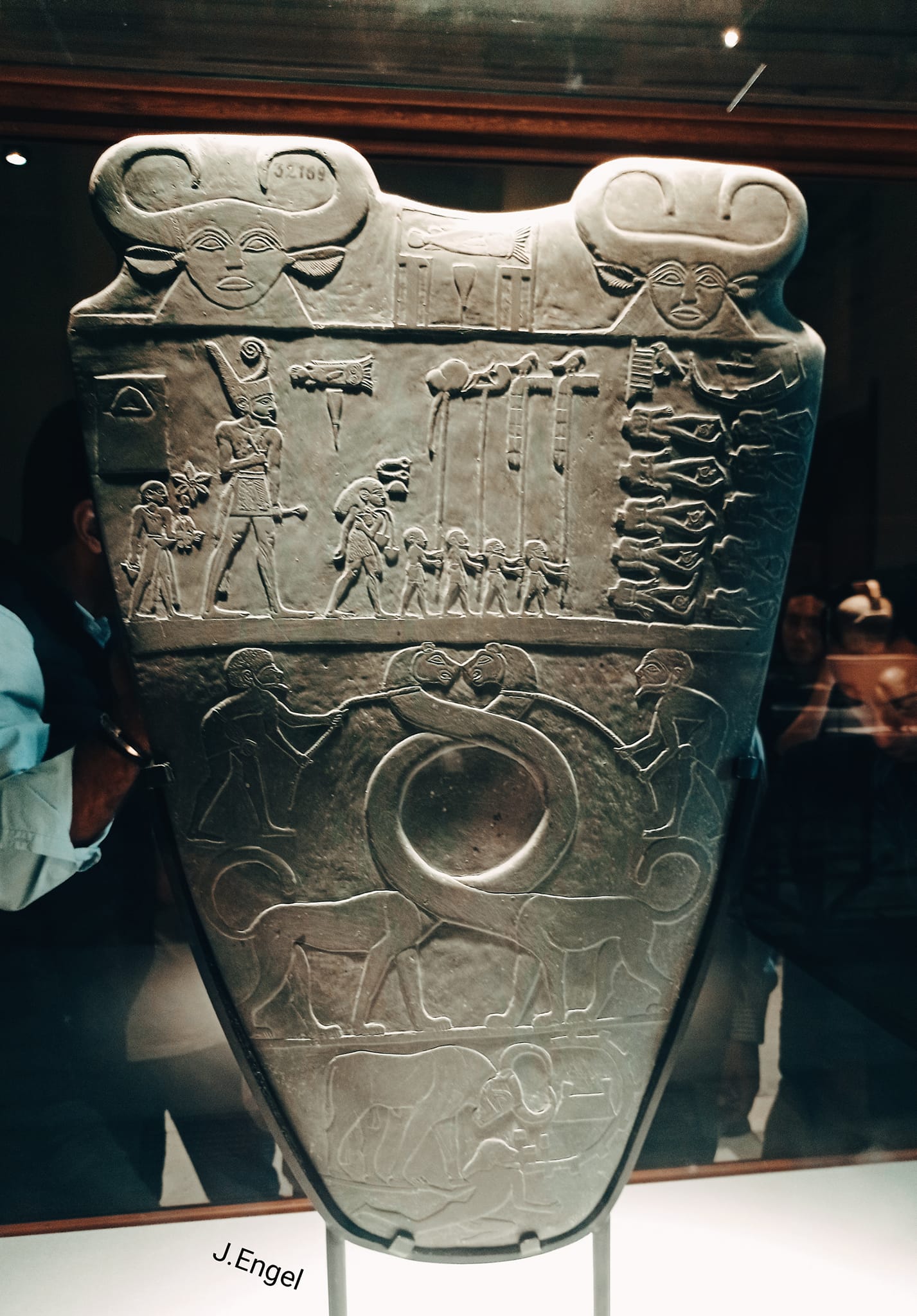
The Narmer Palette

By Jacqueline Engel

The Narmer Palette

This is one of the earliest representations of an Egyptian ruler. King Narmer is shown in the symbolic act of unifying the Two Lands of Upper and Lower Egypt.

His name is written in hieroglyphs on both sides of the palette. The king wears a red crown and processes towards two rows of decapitated bodies. The middle is framed by two mythical beasts controlled by men.

At the bottom, Narmer is shown as a wild bull breaking into a walled enclosure and trampling a figure.

From the later Predynastic period, the king was portrayed as a bull or a lion to symbolise his power.

The palette was probably a ritual object made to be offered or used in temple ceremonies.

Dynasty 0 (King Narmer), about 3000 BC, Hierakonpolis (Temple of Horus), green schist, JE 32169

Text and location Egyptian Museum Caïro

Back to Jacqueline’s pictures
Pictures

Gold Handled Flint Knife

By Jacqueline Engel

JE 34210 (CG 64868) Cairo Antiquities Museum

Material: Flint and Gold Leaf

Size: Length 30.6 CM; Width 6 CM

Location: Possibly Gebelein, Acquired at Qena in 1900

Period: Predynastic Period, Naqada II (3500-3100 BC)

Back to Jacqueline’s pictures

Pictures

Art inspired on the river Nile

By Jacqueline Engel

This frieze is decorated with lotus flowers and roughly triangular tile inlaid with rosettes and a representation of corn chamomile and grapes.

Plaster: Tell el-Yahudia, JE, 21842
Bowl decorated with Lotus Flowers and Goddess Hathor’s Face

These types of bowls which are decorated with lotus flowers were associated with the goddess Hathor. They have a ritual purpose since the lotus symbolized rebirth with each sunrise.
These bowls may contain water, wine, or even milk.

Faience; 18th Dynasty New Kingdom
Ornamented Amarna Tile

This tile is decorated with lotus flowers and representations of the water hieroglyphic sign in the middle.
Both the flowers and the signs are framed with a frieze of geometrical lines.

Faience; Amana Period 18th Dynasty – New Kingdom; JE 5524.


Egyptian Museum Caïro

Back to Jacqueline’s pictures

Pictures

Amenhotep III and Queen Tiye

By Jacqueline Engel

Amenhotep III and Queen Tiye watching the changes in the Egyptian Museum Caïro.

With the imminent opening of the Grand Museum, the Egyptian Museum at Tahir Square is undergoing a metemorphosis.

Many pieces are being restored and are going to the Grand Museum.

Now there is room for other pieces that have been in storage for years.

Also after restoration, they now get a place in the Egyptian museum at Tahir square.

An interesting development!

Everything in collaboration with Museums abroad that have an Egyptian department.

Back to Jacqueline’s pictures