Pictures

Statue of Ramesses II as a child.

SEE ALSO: RAMSES II FANCIULLO CON IL DIO HORUN

This statue represents King Ramesses II as a child, sitting in front of the Canaanite sun god Hauron, who is in the shape of a hawk.

The king is presented in the typical manner for an Egyptian child: naked, his finger to his mouth, with a large sidelock of youth hanging from the right side of his head. He also has a uraeus at his forehead, and a sun-disc above his head. He holds the sw-plant in his left hand.

It has been argued that the statue can be read to spell out the name of the king: the sun-disc represents Re, the child is mes, and the sw plant is the final element Ra-mes-sw. The limestone face of the hawk was found in a separate location from the rest of the piece.

This statue was found in the ruins of a mud brick building at Tanis, which was part of a cluster of structures not far from the enclosure wall of the Great Temple of Amun-Re. This was probably a part of a workshop, for the beak was found in an adjacent room. It was probably in the workshop for repair, which was never completed.

New Kingdom, 19th Dynasty, reign of Ramesses II, ca. 1279-1213 BC.

Grey Granite and Limestone (falcon’s beak).

Tanis Excavation: Pierre Montet’s Excavations of 1934.

Now in the Egyptian Museum, Cairo. JE 46735

Pictures

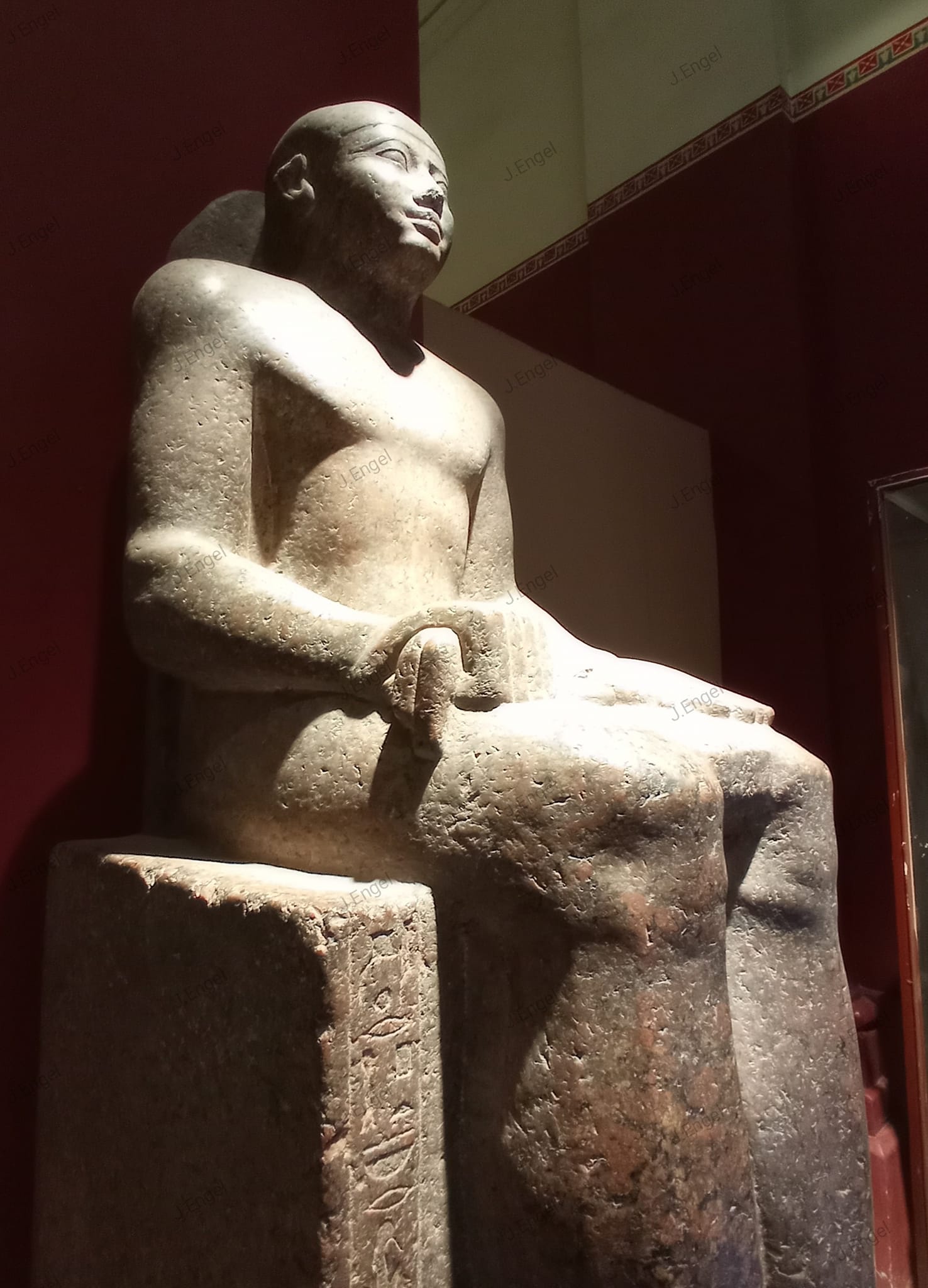
Undescribed Statue

Who is this?

Undescribed statue in the Egyptian Museum Cairo

Next to the Sphinx of Amenemhat III of the 12th Dynasty Middle Kingdom.

Maybe we can find the answer in the hieroglyphics?

Pictures

The Seated Scribe

The Egyptian title for scribe is ‘sesh'().

Scribes recorded the stocks of foods, court proceedings, wills and other legal documents, tax records, and all of the things that happened in everyday life.

Scribes were near the top of the social pyramid. This statue shows an unknown scribe in the traditional position in ancient Egyptian art – seated in a cross-legged pose, with a papyrus scroll over his knees.

The right hand was intended to grip a stylus or reed and is balanced over the open papyrus in the act of writing.

This iconic statue is represented on the 200 LE note.

5th Dynasty, about 2465-2323 BC, Saqqara, limestone, pigment.

Pictures

Head of Queen Hatshepsut

This head comes from one of the twenty-four colossal Osiris statues that decorate the portico of the third terrace of her mortuary temple at Deir el Bahari.

Hatshepsut was the sister-wife of Thutmosis II and became the fifth pharaoh of the 18th Dynasty.

The queen is portrayed as Osiris with male attributes like the ceremonial beard and depicted with reddish-brown skin, a colour usually restricted to men in ancient Egyptian art, in contrast to the pale yellowish colour reserved for women.

New Kingdom

Dynasty 18, reign of Hatshepsut (1479-1458 BC)

Height: 61 cm, Width: 55 cm

Painted Limestone

Place of discovery: Thebes, Deir el-Bahari, Mortuary Temple of Hatshepsut

Egyptian Museum Cairo

Pictures

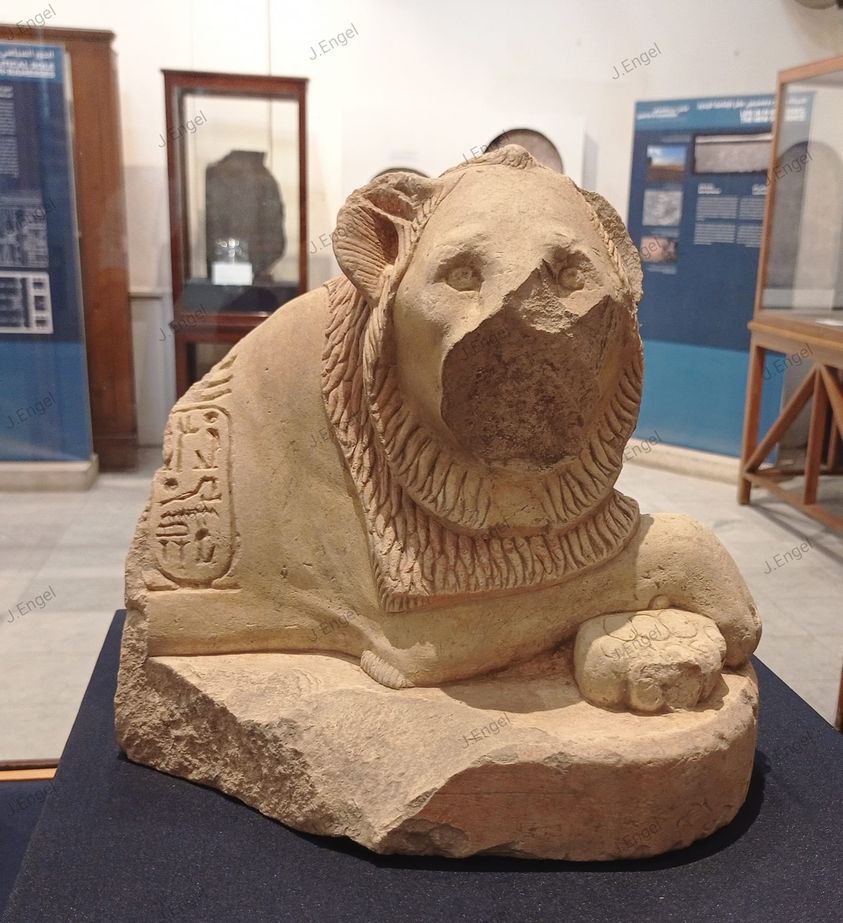
Statue of a Crouching Lion

The lion is shown in a somewhat unusual position, looking to the side.

The name of King Ramesses II is inscribed on his shoulder, and his remarkable title: “Montu in the two lands”.

This is also the name of one of the colossal statues of the king, known as Pi-Ramesses.

Limestone;

Dynasty 19 – New Kingdom; bought in Qantir in 1943; JE. 86121.

Egyptian Museum Cairo

Pictures

Goddess Nephthys

Goddess Nephthys wearing a headdress in the shape of a house and basket watches over the lungs with Hapi.

Four goddesses with open arms watch over the organs of the sovereign.

They are identified by the hieroglyphs on their heads and on the low reliefs of the sanctuary walls.

Each goddess faces and is associated with one of the four children of Horus whose duty was to preserve the king’s organs: the goddess Isis watches over the liver with Imset, Nephthys the lungs with Hapi, Neith the stomach with Duamutef and Selket the intestines with Qebehsenuf.

Characteristics typical of the art of Amarna can be seen in the slight rotation of the statues’ heads (compared to the frontal tradition of Egyptian statuary), the long neck stretching forwards and the naturalistic modelling of the bodies.

Detail of Canopic Shrine of Tutankhamon

Wood lined with stucco and gilded, glass paste

Tomb of Tutankhamon, KV 62

Valley of the Kings

Egyptian Museum, Cairo

Pictures

Bust of a young Roman man

The toga and curled hair indicate that this bust depicts a Roman man of high standing. It may represent a young Marcus Aurelius before he became emperor. His crown with a star-stamped disc, an emblem of Serapis (Greco-Egyptian god of the sun), reinforces this theory. Emperors, as servants of the imperial cult, were tasked with offering sacrifices on behalf of the faithful. Alternatively, the crown may identify him as a priest. This portrait bust was found at Kom Abu Billo (ancient Terenouthis) together with the bust of the early Antonine lady displayed nearby (JE 44672).

Roman, reign of Antoninus Pius, AD 138-161, Therenuthis, Kom Abu Billo, Marble, JE 39468

Pictures

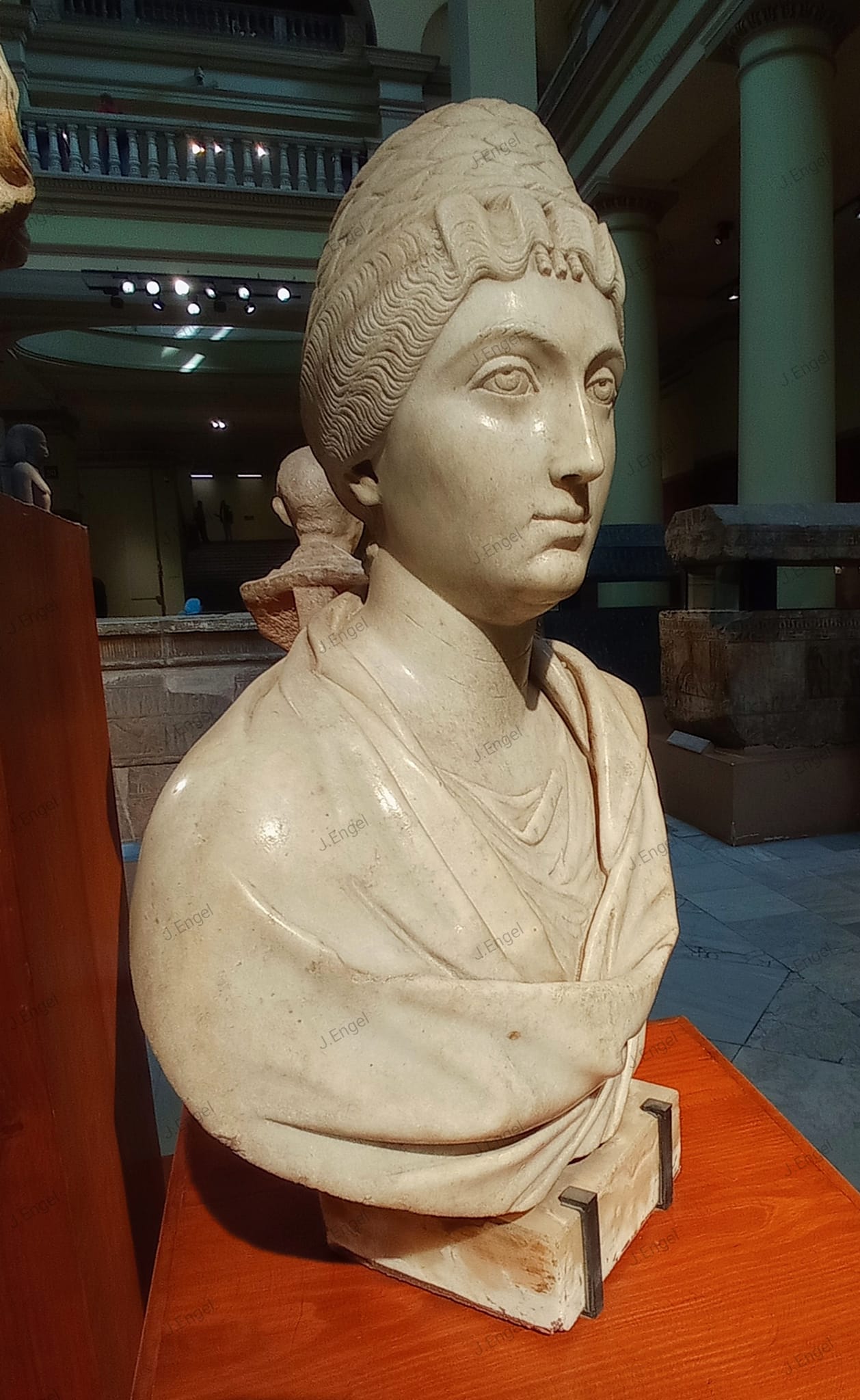
An imperial lady

Busts of this type were popular in Roman Egypt and were often used in funerary contexts.
It shows a middle- aged woman draped in a Greek tunic and a sleeveless coat.
Her elegant hairstyle with lavish braids and curls has been carefully modelled and wrapped around her head three times.
The curls and notches on her forehead confirm her high rank.
Perhaps she was Faustina the Elder, the wife of Emperor Antoninus Pius and the mother of the Roman emperor Marcus Aurelius.
It was found in Kom Abu Bilo the site of a temple dedicated to the goddess Hathor and a large necropolis with tombs spanning the period from the Old Kingdom to the Roman period.

Roman reign of Antoninus Pius,
AD 138-161.
Therenouthis. Kom Abu Billo, Marble, JE 44672

An imperial lady

Busts of this type were popular in Roman Egypt and were often used in funerary contexts.
It shows a middle- aged woman draped in a Greek tunic and a sleeveless coat.
Her elegant hairstyle with lavish braids and curls has been carefully modelled and wrapped around her head three times.
The curls and notches on her forehead confirm her high rank.
Perhaps she was Faustina the Elder, the wife of Emperor Antoninus Pius and the mother of the Roman emperor Marcus Aurelius.
It was found in Kom Abu Bilo the site of a temple dedicated to the goddess Hathor and a large necropolis with tombs spanning the period from the Old Kingdom to the Roman period.

Roman reign of Antoninus Pius,
AD 138-161.
Therenouthis. Kom Abu Billo, Marble, JE 44672

Pictures

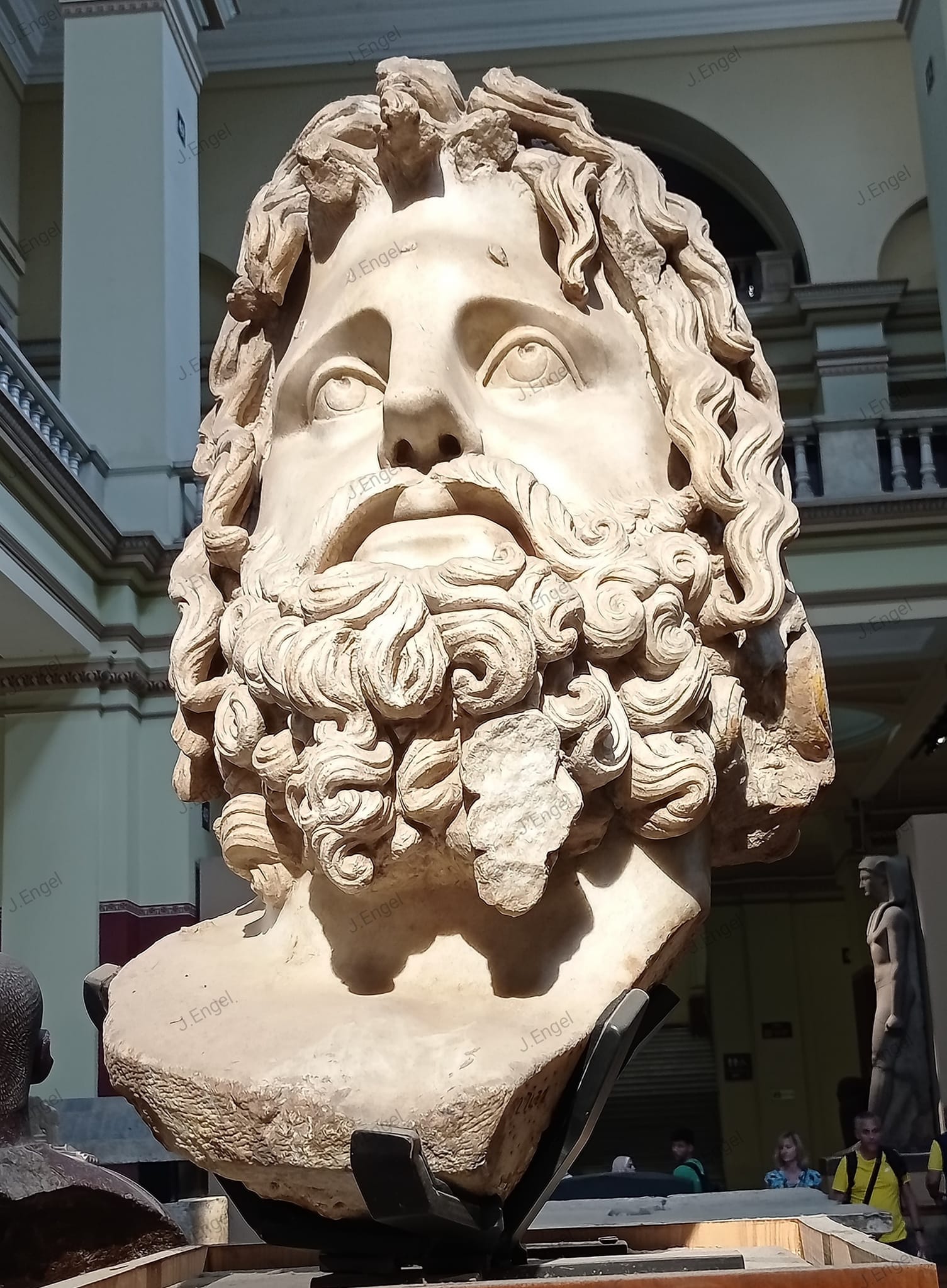
Colossal head of the god Serapis

This head portrays Serapis, one of the most important gods in the Greek and Roman periods. Protector of the Ptolemaic rulers, according to Roman historian Tacitus, Serapis’s cult was established by Ptolemy I following a dream.
The founder of the Ptolemaic dynasty wanted to ensure the prosperity of his new capital, Alexandria. The cult soon spread across Egypt and the Mediterranean.

Serapis combines Greek iconography with Egyptian traditions.
In appearance he resembles the Greek god Zeus-with curly hair and a beard with locks.
His name, Serapis, derives from Osiris-Apis, the sacred bull of Memphis.
His divine wife was Isis and their son Harpocrates. Serapis’s cult was intended to unify the Egyptian and Greek populations.

Roman Period
Probably 1 Century AD
Medinet of Fayum